We’ve rotated enough in our turn around the sun such that in the last week or so, spring has, creeping on little kitten feet, arrived. The wind, while still cool, is soft and mellow and the sun feels fresh.
The sun peeks through bare branches that will soon be leafy.
There isn’t any foliage yet, but it won’t be long.
An azalea bud.
Next week our temperatures are supposed to climb again. Yay!
I am very pleased to host and to introduce you to my long-term blog friend and author, Jacqui Murray, and also to her novel, Endangered Species, the first book in her latest trilogy: Man vs. Nature.
Today, Jacqui will explore the interesting topic of how Neanderthals were able to navigate without a map, compass or GPS; this is followed by an excerpt from Endangered Species. At the end of this post you will find all the book information, social media contacts and other useful links. Please feel free to engage with Jacqui through the comments section.
Jacqui Murray is the author of the popular prehistoric fiction saga, Man vs. Nature which explores seminal events in man’s evolution one trilogy at a time. She is also author of the Rowe-Delamagente thrillers and Building a Midshipman, the story of her daughter’s journey from high school to United States Naval Academy. Her non-fiction accomplishments include 100+ books on tech into education, as well as reviews as an Amazon Vine Voice , and articles as a freelance journalist on tech ed topics.
Savage Land is the third prehistoric man trilogy in the series, Man. Vs. Nature. Written in the spirit of Jean Auel, Savage Landexplores how two bands of humans survived one of the worst natural disasters in Earth’s history, when volcanic eruptions darkened the sky, massive tsunamis crossed the ocean in crushing waves, and raging fires burned the land. Each tribe tarring in the story considered themselves apex predators. Neither was. That crown belonged to Nature and she was intent on washing the blight of man from her face.
In Endangered Species, Book One of the trilogy, Yu’ung’sNeanderthal tribe must join with Fierce’s Tall Ones—a Homo sapiens tribe–on a cross-continent journey that starts in the Siberian Mountains. The goal: a new homeland far from the devastation caused by the worst volcanic eruption ever experienced by Man. How they collaborate despite their instinctive distrust could end the journey before it starts or forge new relationships that will serve both well in the future.
In Badlands, Book Two, the tribes must split up, each independently crossing what Nature has turned into a wasteland. They struggle against starvation, thirst, and desperate enemies more feral than human. If they quit or worse, lose, they will never reunite with their groups or escape the most deadly natural disaster ever faced by our kind.
Join me in this three-book fictional exploration of Neanderthals. Be ready for a world nothing like what you thought it would be, filled with clever minds, brilliant acts, and innovative solutions to potentially life-ending problems, all based on real events. At the end of this trilogy, you’ll be proud to call Neanderthals family.
How did Neanderthals navigate without a map, GPS, or compass?
Natural Navigation is Neanderthal’s preferred method of travel and popular among today’s primitive tribes, hunter-gathers, survivalists, nomads, and nature lovers. It is a method of finding one’s way through a natural environment without the use of any technical tools, just a thoughtful brain and a problem-solver’s attitude. In new areas, Neanderthals developed a sense of their surroundings by being patient, waiting for something to happen, ultimately developing a relationship with the land. It relies on the eleven million bits of data received every second by our senses to assess, extrapolate, and guide, the ones that we modern humans commonly ignore. Our predecessors mixed this with instinct and intuition to live their lives as safely and successfully as possible.
Here are some hints how Neanderthals made this work:
• They learned to sense the weather so they would know when to hunt, They knew from long experience that very little in their surroundings was random and learned to sense what would keep them safe.
• They sat quietly and felt nature around them. The leaves oscillated in the breeze. Sun flecks rolled over the undergrowth. Birds flew by as did insects. They took note of the shapes of trees, the colors of the earth and flowers, the shades of leaves.
• They navigated with shadows. The Siberia Neanderthals might use this to flee West, away from the heaviest smoke and cinder.
• Sometimes, they squinted, to block out most of what they saw and then filter out smaller details.
• The farther away something was, the lighter they appeared.
• The higher the lowest level of clouds, the drier the air and less likely rain.
• All trees have their own unique sound, heard when there was enough wind. Ash–gentle clacking; beech–radio static; aspen–whispering. Neanderthal migrating long distances noticed that the sound of the forest was different than what they were used to.
If you’re interested in the topic, search “natural navigation” in your browser.
Please enjoy the following excerpt from Endangered Species:
Chapter 1 of EndangeredSpecies
75,000 years ago,
What we call Germany today
Jun was lost. Again. He gripped his thick-shafted spear in one hand, throwing stones in the other, and brushed aside the prickle of fear that flooded his body.
It wasn’t being alone that worried him. This was his first time hunting with the clan. He’d wanted to do well.
Initially, Jun had kept pace with the hunters, his strides long and easy, eyes firmly locked on the back of the male in front of him, but—as too often happened—he became distracted by a bird’s call and wandered off to find it, maybe talk to it. Someone shouted his name, far away and so muted, he barely heard it. He didn’t respond, of course. Upright voices would frighten the bird if it hadn’t already fled. He hunkered into the underbrush, reduced his breathing, and squatted there long … longer … but the bird fell silent.
I’ll look for it next time I’m out here.
He stood. Feet spread, ears perked, he twisted around, and to his horror, didn’t recognize where he was. Nor did he hear the sounds of his fellow hunters moving along Deer’s trail.
I wandered farther than I intended, and hurried away, through the leaves and dirt, hoping to find Deer’s trace or his clan’s prints, but found neither so he shouted. The sound echoed harshly through the trees.
No response.
They can’t be far. By now, they must know I’m not with them.
He hugged his arms around his chest, suddenly cold, and tilted his head up. Sun had moved, a lot. Instead of worrying him, it comforted him.
I’ll stay here until they return.
He crouched, picked at the forest’s hearty overgrowth, ate a few worms, and waited. No one came. He called several times, but all he heard were insects, a snake slithering, and squirrels chattering.
I’ll go where Deer is.
He knew where the herd headed because he’d followed it several times to where it ate the fresh young grasses, safe, it thought, from prying eyes. He trotted down what he hoped would end up their trail, searching for trace, listening for the rustle of hide-covered bodies passing through dense brush carrying carcasses. Finally, later than expected, he found Deer’s path, but they didn’t stop in their usual place. They must have known they were being stalked—the hunters were noisy—and trotted into a scree pile as though knowing that would conceal prints, which it did. Jun could either keep wandering until he re-located the clan’s path or make his way back to the camp.
He checked Sun, but it was now hidden by clouds.
He crouched, comfortable in his waiting. No one would be surprised. He often returned late with tales of an excursion rather than armloads of meat to feed the clan. The group would have ejected him, forcing him to make his way alone, but his mother was the clan healer and wouldn’t allow it. She was training him to take over when her stiff joints and failing eyesight meant she could no longer fulfill her duties. He had no interest in illnesses, but understood he must fulfill some duty or lose the tribe’s protection. As a result, he assisted her if he couldn’t avoid it and learned enough about herbs and mulches and poultices to be tolerated.
None of which helped him now.
I can’t wait, and scrambled up a hillock, found a landmark he knew, and headed toward it along a debris-laden forest floor, head up, eyes shut to concentrate on a panoply of delightful odors. He heard the hiss but as background noise to his meandering daydreams. By the time it stiffened his hackles and his eyes popped open, it was too late.
Snake!
Jun stabbed with his spear, to frighten not kill, but missed. Snake didn’t. A blur of movement and pain seared through Jun’s body. He collapsed with a thud and Snake slithered away. Jun attempted to stand and crumpled.
I’ll crawl along the path. The hunters will see me on their way back. Sweat broke out across his forehead. As will predators.
He scuttled into the dirt-clotted root ball of a towering tree, sharing the cozy space with worms, slugs, and spiders.
I’ll call out if I hear someone.
He tamped down the pain and dug through his shoulder sack. No surprise, he forgot to restock his treatments. He tried to blink the dust from his eyes and then rubbed, using the cleanest part of a grubby finger. He mulled over what to do as his ankle swelled bigger than his calf and heat flushed through his body. Everything around him spun and his eyes drooped. The more he strained to think, the more his head throbbed. He tucked his legs against his chest and imagined Snake’s poison infecting his insides.
How do I stop it before it stops me?
He solved it by passing out.
The scrape of a foot awoke Jun. Every part of his body hurt, but he managed to crack one eye. An Upright female not his kind strode toward him, a spear in one hand and a blistering frown on her face. He should say something, but his mouth was too dry.
She acts like she knows me.
He tried to rise, but no part of his body cooperated so he stared at her, worried and somewhat disturbed by the dark fury she directed at him.
Why is she so angry? I’ve done nothing to her.
Seeing his swollen red ankle did nothing to soften her attitude. Disgust washed over her in waves and her fists clenched a rough-hewn lance so tightly, the whites of her knuckles gleamed.
There is something familiar about her….
She had the small skull, long limbs, and narrow torso of a Primitive, lacking the musculature common to Jun’s kind. And it hit him.
“Xhosa?”
She growled in response, a sound so like hatred, he would have pulled back if the tree trunk didn’t stop him.
The female Xhosa visited his dreams often and they got along well. They discussed topics no one shared his interest in—wherethe herds went during their migrations, why Spider’s thin silken strands were so strong, why Sun left if Moon arrived. Did one orb fear the other or had they arranged to share the sky in this way? These types of curious queries annoyed everyone in his tribe, but excited Xhosa.
“Why are you here? I only see you in dreams.” He squiggled, attempted to stand, and collapsed. “Am I dreaming?”
“No, Shanadar. You have forced me to come in person. Night is approaching. It is not safe to be out here alone. Return to your homebase. I have plans for you and being eaten by Cat isn’t one of them.”
Her lips didn’t move nor were her words the clan’s, but heunderstood what she said. He wanted to ask why she cared if the night stalkers ate him, but what he said was something else entirely.
“Snake poisoned me.”
Shock flashed through her eyes and she scowled. “I see. You won’t be leaving on schedule.”
His head spun, started to ask what schedule, but stopped himself. Whatever the answer no longer mattered.
“Xhosa. Snake killed me. Well, there are treatments for Snake’s venom, but I didn’t bring them. Mother has them, but I can’t get to her fast enough. And the hunters—I don’t know what happened to them. They should have come by now….”
His voice trailed off. Talking exhausted him. Still, he owed her one more explanation. “Whatever your plan, it can no longer include me.”
She dismissed him with a flip of her fingers. “You’re not going to die, Shanadar. Come. My kith can take care of you.”
“Shanadar,” he mumbled. “She keeps calling me Shanadar.”She didn’t explain why and he didn’t ask. Or mind.
But he did ask about kith as Xhosa yanked him to his feet—foot, the injured one dangling uselessly above the ground—encircled her arm around his waist and draped his around her shoulder before replying.
“You call your group a clan. Ours is kith. The Tall Ones are a band, the Canis Pack.”
Tall Ones? He tried to make sense of her answer, but the words got lost in his muddy thoughts.
I’ll ask later.
They slid through the forest, well beyond his clan’s area and Deer’s favorite eating spots, past a tree tall enough to touch Sun. He’d never seen it before. Did it just grow? Soon, they reached a gathering of Primitives the size of Jun’s clan crouched by an overhang. All had low foreheads, prominent brow ridges, andbody shapes like a shorter version of the tall slender strangerswho occasionally passed through the clan’s territory—
That’s who she called Tall Ones!
The kith members wore long wraps or capes like Xhosa’s, unsewn, as though they simply cut a hole in a pelt big enough for their head to push through. No capes or wraps, and foot coverings were fur or bark strapped to feet.
But the dark, deep eyes, fixed on the new arrival, shone with intelligence. They blinked a greeting before resuming theirwork.
“They expected us?”
“No. They have adjusted to strangers trailing in here withme.”
Jun’s eyes popped open. “Other Uprights?”
She chuckled, the first smile he’d seen from her since she showed up. “Usually pawed and tailed.”
He had no idea what to ask about that and didn’t bother trying. Ignoring the growing ache in his leg took all his energy. She has much to explain, but it will wait until I recover.
Xhosa pushed him gently toward a boulder. “Crouch there.”
He collapsed. His good leg was numb. Even if she hadn’t told him to rest, he couldn’t have gone farther. The relief to his pounding ankle was overwhelming. He stilled his entire body, his breathing shallow as another Primitive approached, holding supplies eerily similar to those Jun’s mother carried. Then, before he could blink, she cut across Snake’s puncture and squeezed. He started to scream, but stopped because he felt nothing. The poison dried up and Xhosa scrubbed the puncture. Once she deemed it clean, she applied moss to suck out new impurities, as his mother would. All Xhosa’s ministrations were like his mother’s except Xhosa’s didn’t hurt. Mother’s always did.
Xhosa rotated back on her heels with a grunt of either satisfaction or hopelessness. Jun was too hot, tired, and sick to care.
She stood. “I will deposit you where I found you. You will awake groggy, feeling unwell, but you will be fine.”
Jacqui Murray is the author of the popular prehistoric fiction saga, Man vs. Nature which explores seminal events in man’s evolution one trilogy at a time. She is also author of the Rowe-Delamagente thrillers and Building a Midshipman, the story of her daughter’s journey from high school to United States Naval Academy. Her non-fiction includes 100+ books on tech into education, reviews as an Amazon Vine Voice and a freelance journalist on tech ed topics.
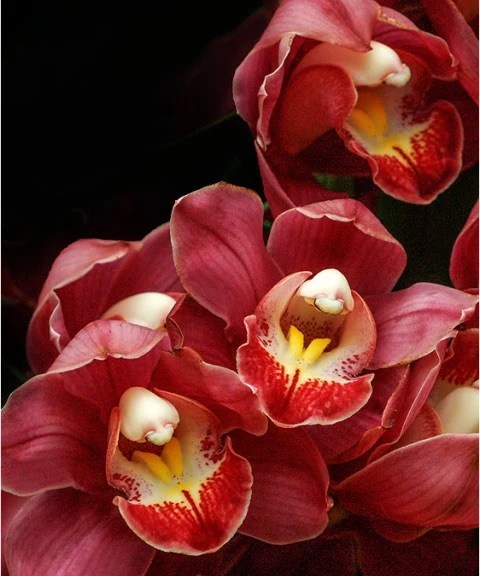
Beautiful orchids from Jonathan at Helluva Times. Please click the link above to see more of his stunning photography, especially of flowers. Gorgeous.
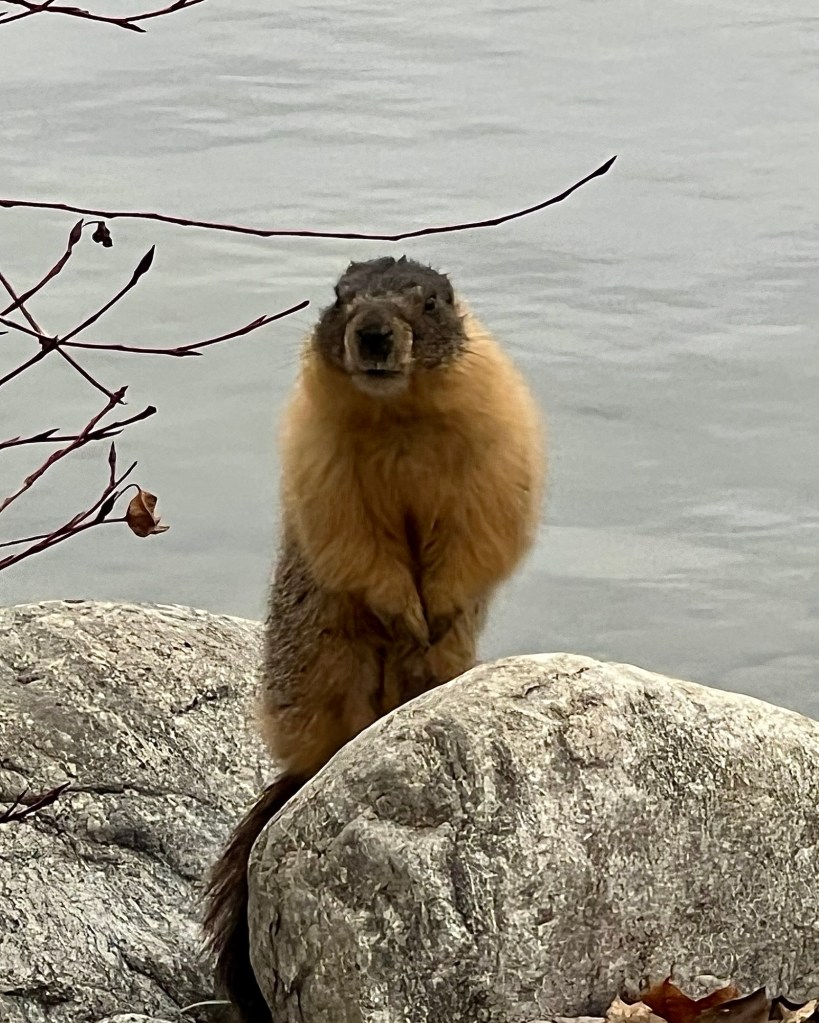
Yesterday I saw a marmot! Definitely an excellent sign of spring as these members of the squirrel family only emerge from hibernation when it’s warm enough.
But … I only saw one. Maybe the advance marmot checking out the weather?
This individual is part of a large colony of yellow-bellied marmots who live under the breakwater boulders at the edge of the lake. As long as you don’t get too close, they’re happy to let humans observe them as much as they like.
Marmots are the largest and heaviest members of the squirrel family but behave quite differently. Not only do they hibernate and live together in large colonies, they also are very affectionate with each other, even going to the extent of sharing their food.
Although this was a lone sighting, it was great to see him and recognise what he portends!
We have warmed up substantially and the cold wind and intermittent wet snow flurries have been replaced by more comfortable temperatures, overcast with sunny breaks and drizzle.
I like the look of these cloud striations.
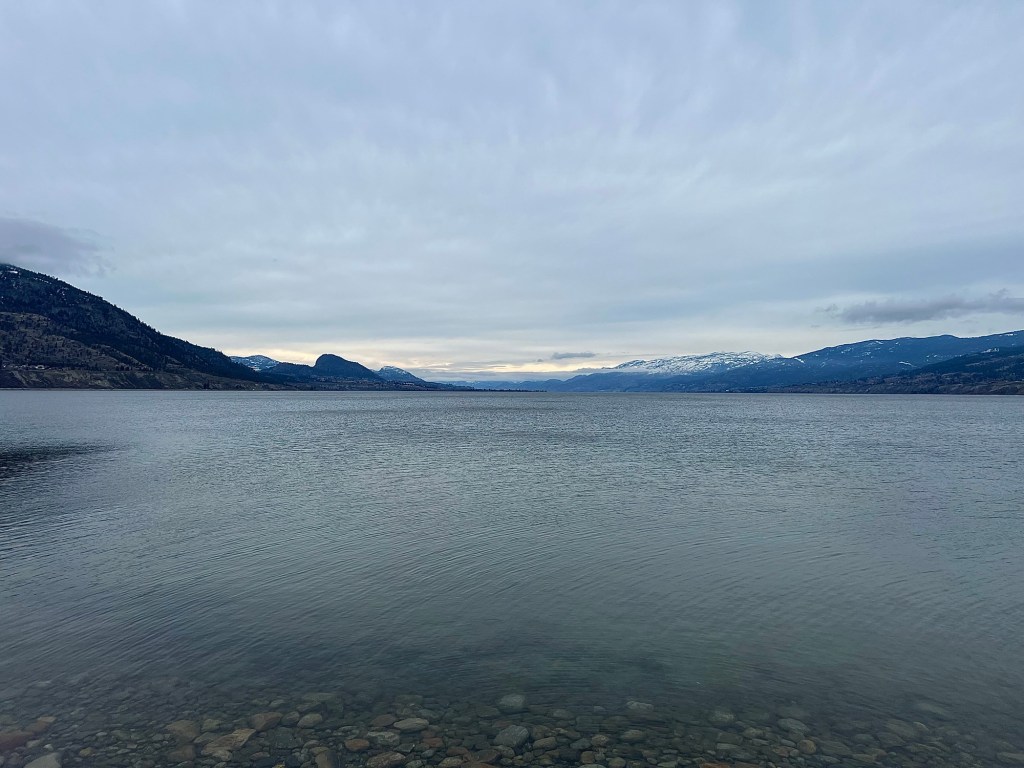
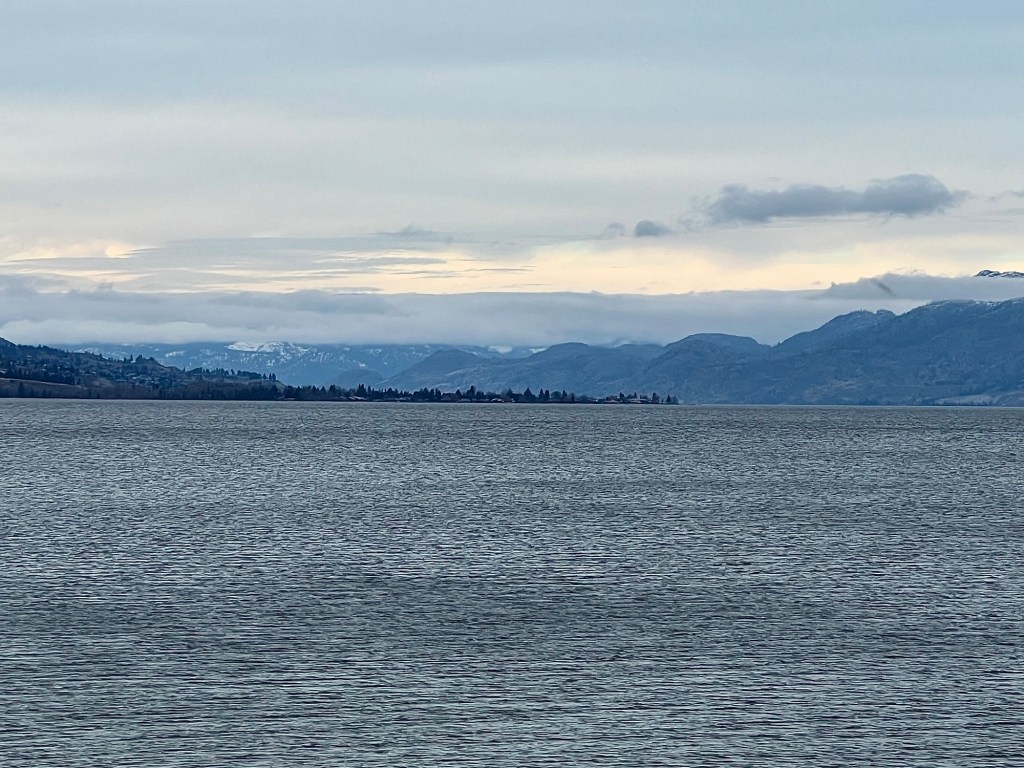
Okanagan Lake is much calmer, the shoreline ice pans have melted and somehow, it’s starting to feel spring-like.
The overcast and drizzle definitely haven’t dampened that sense. Spring showers bring May flowers? Could be, although it’s technically not spring yet.
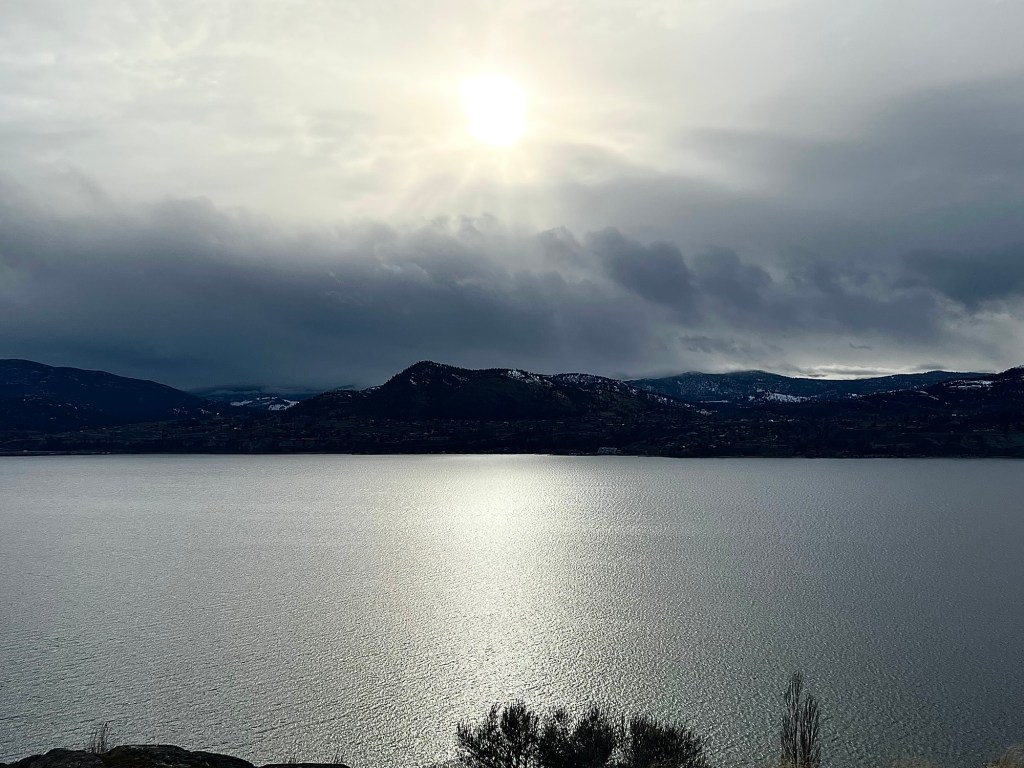
Through the cloud and drizzle we have had some sunny breaks, and those feel very, very nice. The black spots you can see in the foreground of the picture above is a large group of coots. They overwinter here and another good springish sign is that I think most of them are getting ready to leave although a few will stay to nest.








 In the Net! - Pictures and Stories of Life