While visiting Iceland earlier this month, we were caught in some bad weather just as we were slated to travel back to the south. You can read my last post about that here: https://lynettedartycross.com/2024/06/09/northern-icelandic-weather-part-i/
As I mentioned in that post, we were in for a bit of a surprise. We left Húsavík and while on our way to Akureyri thought that the weather was improving.

We had a booking for whale watching the next day, but during the night, the predicted storm started giving us quite a shellacking.

Awakened by the wind at about 3:00 a.m., M looked outside to check on the weather (that far north it was still light out) and saw that the snow was blowing parallel to the ground with gusts of about 80 km (50 miles). Our whale watching was a definite cancel, but we were worried about getting back to Reykjavik for the day after, and anxiously kept track of road conditions for the following 24 hours.
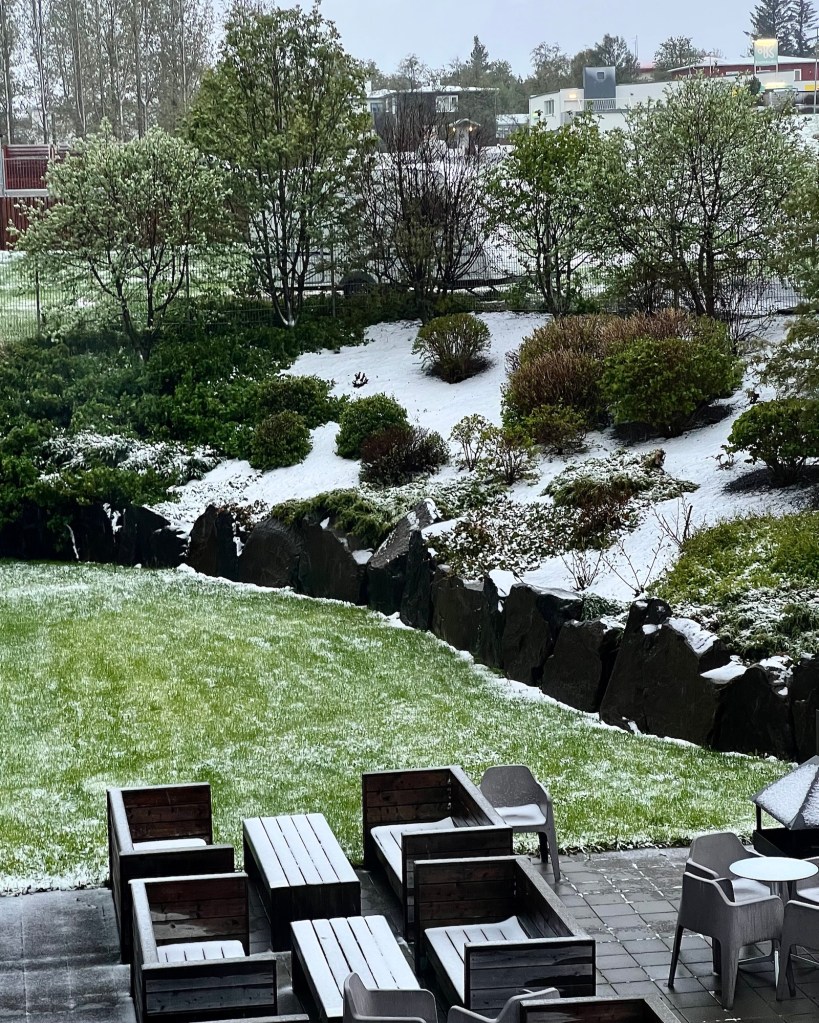
But none of what we were seeing on the Icelandic highway app was reassuring: gusts to 90 km (56 miles), ice pellets, snow, freezing rain, temperatures around +1-2C (33-35 F), completely perfect conditions for dangerously ice covered roads with obscured visibility.
We awoke bright and early the next morning to find that the main route – highway one – to the south was closed in at least two places.

We went to breakfast to drink coffee and to think this one through. There were things on our side. We’re very experienced in winter driving conditions and have literally seen it all, including driving through the Rocky Mountains during a December ice storm. We had rented a four-wheel drive manual which gave us some snow clearance and traction, and lastly, we had the time to drive very slowly.

We decided to take the chance: the road closure was 1.5 hours away, and we thought that clearing and sanding might have occurred by the time we got there, given that this is the main highway. We pulled out of Akureyri with a stockpile of trepidation and all the supplies we would need to wait out the storm in our vehicle if necessary.

At first, it wasn’t too bad, but then we had this:

The snow ruts were ice encrusted and caused pulling to the left or right if we had to move out of them. This is actually a two-lane highway, but with all the snow buildup, you wouldn’t know it.
When we arrived at the first closed section, snow clearing had already occurred and the road was open once more, but then we also started descending from the highlands, and within 30 minutes had much better conditions.

We were delighted to get out of that weather, and the further south we went, the better the weather became.

When we stopped to stretch our legs and pry our tense fingers off the steering wheel, we were even rewarded with a foss, or waterfall.

All’s well that ends well. Happy Friday.



 In the Net! - Pictures and Stories of Life