

Tag Archives: society

Is He or Isn’t He?

The following is an opinion piece by columnist Andrew Coyne originally published in The Globe and Mail on August 29, 2025. Given Donald Trump’s behaviour and the unwillingness or inability of those around him, including Congress, to exert some control over him, the issues and questions that Coyne raises in this article are particularly germane, especially in light of Trump’s continued threats against our sovereignty and our right to exist as a country.

Donald Trump is on the brink of becoming a dictator. Can he be stopped?

~ by Andrew Coyne

Donald Trump’s giant portrait hangs on the Labour Department headquarters near the Capitol in Washington, on Monday. (Associated Press)

By now it should be clear that the subjection of the United States to the dictatorship of Donald Trump is no longer a theoretical possibility or even a distant probability. It is an imminent reality.

It is not here, quite – critics of the President remain at large, the courts are still attempting to enforce the rule of law, the results of the 2026 and 2028 elections have not yet been determined – but the pieces are being put in place at astonishing speed.

To call what is happening a “slide” into authoritarianism, as if it were something anarchic and uncontrolled, would not be apt. It is more like a cementing. Having slipped back into power by the narrowest of margins, Mr. Trump and his acolytes have been steadily expanding from that beachhead, each new power serving as the means to acquire still more.

Often these powers have been acquired illegally, in brazen defiance of the Constitution. But so long as no one holds them to account for it, and so long as the administration refuses to be held to account, they become ratified by convention, or practice, or sheer nerve, the de facto rapidly congealing into the de jure.

At some point, American democracy will find it is caught, immovably, a colossus in quicksand. The question is whether it has reached that point, or, if it has not reached it yet, whether it can still avoid doing so.

The examples pile up by the day. In recent days, weeks and months, Mr. Trump and his officials have:

  • Installed National Guard troops and other military forces in the centre of major American cities, first Los Angeles, then Washington, and soon (if Mr. Trump’s threats are to be believed) Chicago, Baltimore and New York, under the guise of fighting crime. Some of the guardsmen are armed; some have been conducting arrests, for which they have neither training nor authority. The D.C. police force was likewise taken under federal control.
    • Seized thousands of suspected illegal immigrants off the streets, the snatchings carried out by masked Immigration and Customs Enforcement (ICE) agents without badges, their victims bundled into cars without markings, to be sent in some cases to barbaric foreign prison camps, in some cases to their domestic counterparts, without trial, without even charges. ICE is increasingly seen as Mr. Trump’s personal police force.
    • Initiated criminal investigations into various of Mr. Trump’s antagonists, from Letitia James, the Attorney-General of New York who prosecuted him for fraud, to Jack Smith, the special counsel who prosecuted him for his attempts to overturn the 2020 election and for his handling of classified documents at Mar-a-Lago, to John Bolton, his own former national security adviser who has since become one of his severest critics, to Adam Schiff, the Democratic Senator and lead manager on his first impeachment, to Lisa Cook, the Federal Reserve governor who stands in the way of his desired takeover of the U.S. central bank.
    • Fired or demoted police officers and prosecutors responsible for bringing the Jan. 6 rioters to justice, having earlier issued a blanket pardon for the rioters themselves.
    • Threatened television networks whose programs or performers irritated him with suspension of their licences, or adverse regulatory rulings.
    • Extorted massive settlements from the same networks, or law firms who had acted for his antagonists, or universities he deemed too liberal, or even corporations, like Intel, he fancied a piece of.
    • Demanded Texas, Florida, Indiana and other states redraw their electoral maps, in a transparent attempt to gerrymander more Republican districts into being in time for the midterm elections; at the same time, Mr. Trump talks openly of banning mail-in ballots, while issuing executive orders demanding “proof of citizenship” for voting and requiring federal review of state electoral rolls.
    • Fired the head of the Bureau of Labour Statistics for issuing unemployment numbers that displeased him; fired the head of the Defence Intelligence Agency for issuing after-action reports on the U.S. bombing of Iran that likewise disagreed with Trumpian dogma.
    • Defied court orders with regard to various of the above.
    • Defied Congress with regard to the spending of money for the purposes for which it was appropriated by Congress, while imposing tariffs that must constitutionally be approved by Congress.
    • Issued a series of executive orders for which he has likewise no constitutional authority.
    As if to give visible signs of his intent, Mr. Trump has been furnishing himself with various of the accoutrements of a dictator, from the giant portraits that now hang on government buildings, to the gold-encrusted palace that was once the White House, to the military parade on his birthday, to the endless public displays of sycophancy he requires of his cabinet members. Indeed, he has taken in recent days to musing about dictatorship as a possibility – “a lot of people are saying ‘Maybe we need a dictator’” – as if he were not just trying out the description with the public, but habituating them to it.

Indeed, the portents are ominous. Commit violence on Mr. Trump’s behalf, and he will see that you suffer no penalty. Attempt to stop or prevent it, and he will have you fired or prosecuted. Criticize him, or represent his critics in court, and he will lean on the organization that employs you.

Think the courts will save you? He has stacked many of them, intimidated others, and will have no hesitation in ignoring those that remain. You can see him lining up a test case for the ultimate act of revolutionary disobedience, defying a Supreme Court ruling – maybe over tariffs, or illegal immigrants – and with it finally dispatching with the rule of law altogether.

Certainly he need have no worry about his own personal legal liability: the Court has already found that he is immune from prosecution, at least for acts committed in his “official capacity.” But who would even attempt to bring him to justice? The senior levels of the Department of Justice are filled with political allies or his personal lawyers.
The Congress? But both houses are controlled, narrowly, by the Republicans, and while Congresses in the past have been willing to face down a President of their own party, the current GOP is made up of individuals who either share his dictatorial world view or are too frightened of him, and even more of his followers, to stand up to him. That is only likely to grow in line with his powers.

Ah, but there are next year’s midterm elections. Mr. Trump’s approval rating is mired in the high-30s. The Senate may be out of reach, but surely the Democrats can retake the House. Then the process of reeling in Mr. Trump can begin.

But you haven’t been paying attention. What do you think all that gerrymandering is about? Why do you think Trump is ranting about mail-in ballots? What else do you suppose is being arranged at the state level, out of reach of the national media? The chances of a free and fair election in 2026 must be rated at 50-50 at best.

Suppose the Democrats do retake the House. How do they enforce their will on a President who does not recognize the legitimate authority of Congress? By appealing to the Supreme Court? But we know Mr. Trump’s view of the rule of law. How many divisions does the Supreme Court have?

And as you ponder all this, remember: It’s only going to get worse. We are still in the very early days of this presidency. Mr. Trump’s behaviour has grown steadily more outlandish throughout, trashing norms and stepping over boundaries previously considered inviolable even by him. How much more outlandish is it likely to get between now and January, 2029, when Mr. Trump’s term is supposed to end?

Emphasis on: supposed to. As others have observed, Mr. Trump has not been carrying on like someone who expects to leave office in three-and-a-bit years. (That US$200-million ballroom he is building off the White House – or perhaps the White House is off it – is a clue.) He seems entirely unconcerned by the political opposition his actions have aroused, except to revel in the possibilities for repression they open up.

So 2028 rolls around. Maybe Mr. Trump runs again, as he sometimes muses, in violation of the U.S. Constitution. Or maybe he doesn’t. Maybe the election is free and fair, or maybe it isn’t. Maybe he just stays on, indefinitely. But whatever happens, how exactly is Mr. Trump to be removed from the White House? I mean physically.

By that time he will have replaced the entire command structure of the military with his loyalists. And of the intelligence agencies. And of the FBI. D.C. will have been under martial law for three years. Who, or what, is going to arrest him?

If this sounds over the top, then again you have not been paying attention. Everything Mr. Trump does defies belief, let alone precedent. Mr. Trump’s dash for dictatorship is rapidly approaching the point of no return. So the question that has always hovered in the air is now the urgent question of the hour: How can he be stopped – before it is too late?

That Mr. Trump is bent on making himself dictator is no longer in doubt. That he is well on his way to doing so should not be. If democracy in America is to be saved, its defenders must pour all their thought and energy into devising creative ways to frustrate his ambitions. Because they are running out of options, and out of time.
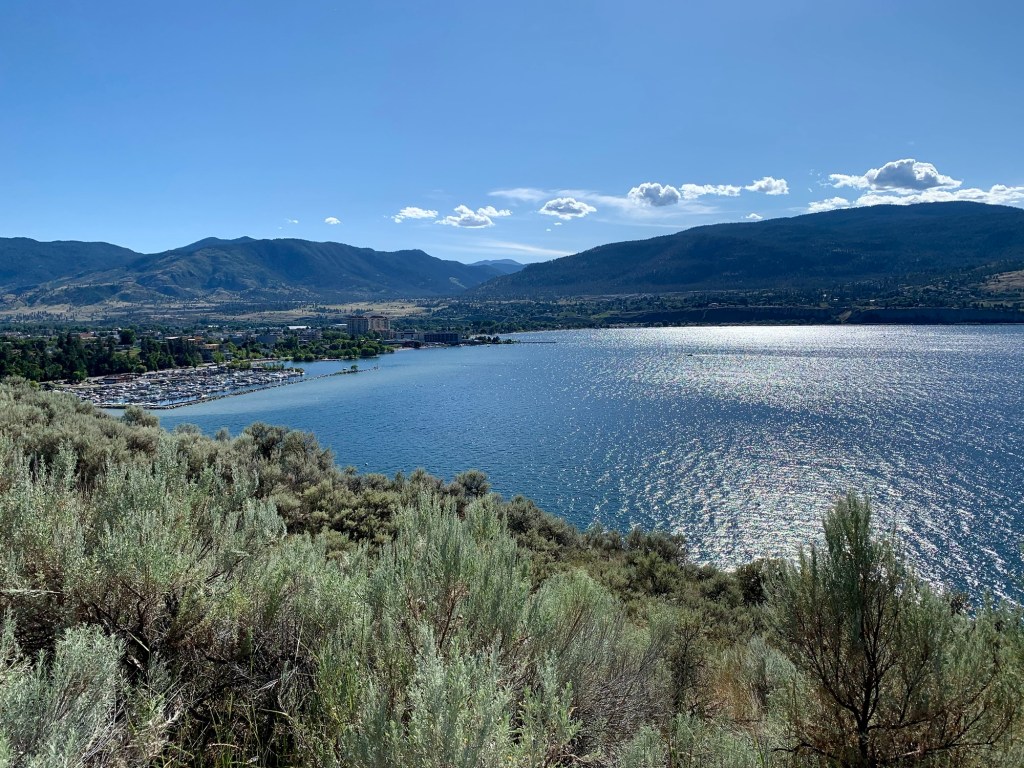
Blue is the Hue

Blue is a favourite colour. Rich, cool, elegant, business-like, cerulean, lapis … no matter how you describe it, blue is rather versatile.

I’ve always found it to be calming and relaxing; when I was tired after a long, difficult stint at work, just looking at the blue sky felt very comforting. The issues were still there, but I felt better.

I vividly recall coming to the Okanagan Valley for a beach holiday three months after the start of Covid. My brain felt drained, and so knew I needed to recoup.

M and I sat comfortably on Skaha Beach, swimming when we got too warm but mostly lounging with our feet up, the cooler nearby, a book in hand.

But reading wasn’t what I wanted to do. I simply sat and observed the blue water and blue sky, mind pretty blank, and began to feel rested. This simple activity was marvellously tranquil and relaxing; it was such a wonderful thing.

I’ve read that blue and green are both comforting colours, and I’ve found that to be true. I think one of the reasons why sunny days and long walks or hikes outside are so good for us isn’t just because of the physical benefits; the act of just being outdoors is so good for the brain and our general well being.

Happy Thursday.

It’s Been A Long Time – from Ramblings

So many years since I have ventured into the WordPress realm. Much has changed & I’m trying to get my head around it. Hopefully it posts OK. Hello …

It’s Been A Long Time – from Ramblings

An old blogging friend – from the time I first started 12 years ago – has returned to blogging after caring for her elderly parents and subsequently writing a book about her experiences. Please click the link above to learn more about her book and how to order if you’re interested.

What should I wear? Gen if I know… #humor #

Gen Z knows what Gen X should wear, and Millennials don’t have a clue. But I have it in my closet… I saw a story in the New York Times about …

What should I wear? Gen if I know… #humor #

I hope you enjoy this hilarious post from Barb Taub. I’ve been told what to wear since as far back as I can remember, and like Barb, I’m definitely done with listening or complying!

Respect, Gratitude, Humility … Where Do You Stand?

Week 36: Helicopter Parent
Week 36: Helicopter Parent (Photo credit: WilliamsProjects)

Right now it is very fashionable to worry about the under-30s and how entitled they behave; the complaints about them are legion and growing. Prospective employers tell scary stories about helicopter parents accompanying their 28-year-olds to job interviews while university profs talk about the parents who wait outside their office doors and demand to know the grades of their 20-year-olds. Adult children populate the homes of their parents long after they should be on their own, and in many cases, the parents are quite happy to accommodate them, even if these kids are married and have kids of their own. Books abound about how we have produced an entire cohort of self-involved, pampered, physically and intellectually lazy bores, and educators have been blamed for developing a cult of over-esteem. However, I have a somewhat different label to hang on them.  I think it’s more that they have been infantalized, and that, in and of itself, is rather dangerous; many people suffer from narcissism because they were stopped in their emotional development at a very young age. Nevertheless, it’s more likely a form of narcissism on the part of their parents: the parents want the children to be a reflection of themselves and their perfect lives; therefore enormous control over every detail must be exerted.

There’s too much concern over this, however. There is perhaps much more narcissism among the under-30s than there used to be, but I believe that given a chance, many will outgrow this or maybe, recover from it. Remember the “me” generation? The “yuppies”? Remember the “Material Girl”? Madonna? Still material, as far as I can tell, except now she’s collecting kids instead of music awards. Anyhow, I’m dating myself here but that is my generation – the baby boomers – those born between late 1946 and early 1966. A 20-year span. The war years that interrupted the lives of our parents and caused them to want a better life for their offspring literally came true, in a material sense anyway, no pun intended.  Driven by consumerism and one-upmanship, we have been characterized as having stepped on anything that got in our way. My generation, the later ones, anyway, make up many of the helicopter parents that we see now. I might very well be wrong, but I tend to see my own generation as having been worse than the under-30s of today. Frankly, the hallmarks of narcissism are much more prevalent among my generation – the grandiosity, the rampant spending and consumerism, the self-absorption and to add to this, the lack of respect, gratitude and humility. We are supposedly the best of the best, and because there are so many of us, we can make a lot of noise and can often get our way. In other words, if we don’t get what we want, we throw a narcissistic tantrum, and that applies to our kids, too.

The fact is that many of us raised our kids in environments that while perhaps not narcissistic per se, certainly were driven by narcissistic tendencies, and a lot of us continue to see these kids as extensions of ourselves. Many of these kids then find themselves stuck between being children and being adults; they occupy some sort of childish purgatory where they never really grow up. The only way for them to get out of this netherworld is to fight, which is an affront to us as parents. Our kids are supposed to be perfect!  We have taken huge steps and made great efforts to prevent our kids from making any mistakes, no matter how minor. Why, then, are they doing this to me, we cry. Why do they want to leave us?  We leave them lost in a vicious circle that’s difficult for them to escape: they want their independence and they also want a good relationship with their parents; that’s hard to achieve if the parents are needy, clingy, controlling hangers-on who, let’s face it, may resort to manipulation to stop their kids from passing into true adulthood.

There’s also the danger, as I mentioned above, that they might become narcissistic themselves or may have to recover from living in an environment that, at a minimum, was emphasizing some of the characteristics of narcissism. If our children see themselves as entitled, then we only have ourselves to blame, never mind the fact that we have saddled them with a difficult, life-long issue.

The words respect, gratitude and humility come up often when people start discussing the under-30s. They lack respect for the work it takes to earn a dollar. Helping out or contributing to others are foreign concepts. All they care about is the latest iPhone and who posted what on Facebook. There’s no gratitude. They don’t know how to say thank-you. If they want something, they expect you to provide it for them, no matter what it costs. They’re pretentious, self-important and full of themselves. They don’t know how to work hard and expect immediate promotions and lots of perks. They believe that they should be able to leave work or take days off whenever they want to. They’re much too good to start at the bottom and work their way up. They don’t know what the word humility means. Actually, this is a very good capsule description of my ex-narcissist, Harry. In light of this, perhaps we should be more concerned about the narcissism of the younger generation than we are.

I have heard these kinds of complaints over and over again, and I have to say that I have seen lots of evidence of it, too.  But I also remember the things that were said about my generation, too. It was odd. On the one hand, my parents wanted us to have everything; they spoiled us rotten. On the other, though, the most common complaint about us was that we “had it easy.” There were also these stories about how the weather patterns were much worse then and how they had to endure switchbacks on their way to school, resulting in them having to walk uphill both ways.

But I digress. Mixed message? Yup. And compared to my parents, I certainly did have it easy. At age 16, my mom was in the army and dodging bombs in London. At 22, my dad was trying to escape Dunkirk. The fact is, however, would they have wanted us to experience a war so that we could understand that we had it easy? What kind of logic is that? At times, however, I felt that that’s what the message was. They wanted us to have what they didn’t have, but at the same time there was a great deal of guilt-inducement going on: look at what we have done for you, and all you want to do is grow your hair, get stoned and sit around. The problem is that they wanted us to understand what it cost them to provide this great life for us, but they weren’t very good at expressing that and we were too self-involved to try to get it.

There were lots of people who behaved that way. On the other hand, there were lots of American baby boomers who tried to stop the Vietnam War. All over the world, there were lots of  hippies who tried to make love, not war. There were those who had to endure a war themselves. I was too young for any of this, and I otherwise know only a couple of people who participated in these things. They then went on to become rather narcissistic, consumer-driven yuppies.  For me and most of my peer group, however, things were rather different. I worked hard. I put myself through school. I joined the army. I started a career that has given me a comfortable living but has not made me wealthy. I have never owned a BMW. For the most part, life has been pretty good. I pay my bills and my taxes and I vote when there’s an election. I’m fortunate enough to have been born in a country that doesn’t have a coup every time there’s an election. In other words, I think that despite the fact that I “had it easy”, I turned out all right, as did most of us. I have even learned to appreciate my parents and what they wanted for us.

Does my generation show some pretty incredible characteristics of narcissism? You bet. Have I at times been egotistical myself? Yes! I don’t know anyone who hasn’t. And because of our size, we do get a lot of attention. But we’re mostly okay, and we have even managed to do some pretty valuable things.

And the under-30s? They will have to deal with the way they have been infantalized and they will have to find their feet and fight. They have a steep learning curve ahead of them. But there are many good things about them, too, and like us, most of them will be fine, and in the end, I doubt that they will be any more narcissistic than any other generation.

So let’s stop complaining about them, shall we?