I originally posted this piece back in 2022. Here it is again, updated but still appropriate, I think. Cheers.
Today is St Patrick’s Day, and although I don’t have any Irish antecedents, my husband does. He is half-Irish. In fact, his surname is so Irish that it glows green in the dark.
I don’t really understand why St Patrick’s Day has become so popular – is it the green beer? the riddance of green snakes? – but since I’m a half-French frog, I do understand the green background and that it confers a certain ability to stand up to the preconceived notions of others. Nevertheless, as Kermit the Frog so famously said, “it’s not easy being green.”
So here’s to the Irish! May they live as long as they want, and never want as long as they live.
Since reaching my sixties, I’ve noticed that decidedly nonchalant, seemingly socially accepted forms of ageism are leaking out in all directions from some of the younger amongst us and particularly against me or anyone else who shares my age-region. To say the least, it’s incredibly annoying.
For instance, why is it that I’ve suddenly become “dear” – and intoned in such a way as to communicate that the speaker sees me as mentally deficient – to anyone under 50? I don’t know you, I’m not your granny or auntie or even a neighbour. But in any case it’s not just about knowing me; it’s about implying that I’m a sort of child-senior who deserves condescending endearments from total strangers.
Another thing is the amazement I sometimes hear about my ability to use technology. Comments such as “how great that you know how to do that,” it’s nice that you’re not afraid of technology” or this zinger: “you’re doing so well for your age.” Ugh. Here’s the reality: I’ve been using computers for 40 years and have had a smartphone since you were in kindergarten. I’m no stranger to computers, the internet, apps, digital wallets and streaming. My generation invented this stuff!
Just because my hair is grey doesn’t mean that a) I’m hard of hearing or b) half-blind. Neither has intimacy gone the way of the dodo bird.
I am not “cute.” Babies, puppies and kittens are cute. I left cute behind many moons ago.
And another thing, we Gen-Xers and Boomers didn’t have it easier when we were 20-and-30-somethings: 20% interest rates on loans, the cold war, unemployment, stagnant wages, gas shortages, a couple of shorter recessions in the 70s followed by a real humdinger in the 80s. Buy a house? The closest I could have gotten to it would have been a dollhouse.
No, I don’t have dementia. Yes, my systems are ageing. Nothing works as well as it used to but I’m not a doddering old codger … er, codgerette. I’m a lot like the 18-year-old, manual Ford that’s parked in my garage. It has been and continues to be a great car and as time goes along, it needs more maintenance and even some fixing. But care will extend its useful life, just as it will for many of us.
I’ve dealt with discrimination from time to time, especially when I was younger. As I was coming of age, behaviours were easing up a little but it still wasn’t easy being female. Or being French, female, and pursuing a “non-traditional” career. And now this old age thing? It only feels like yesterday that the ageism came from the other end of the spectrum. Yikes.
Greenland is part of the democratic Kingdom of Denmark and as such, is part of a sovereign nation that is also a member state of the European Union and NATO. I have visited Greenland several times; its people are friendly, peaceful, tolerant and harmonious. But now because of the greed of one man and his gang of thug-puppets, these peace-loving people are under serious threat. They are scared and worried that their democratic right to choose their own destiny is about to be stolen from them.
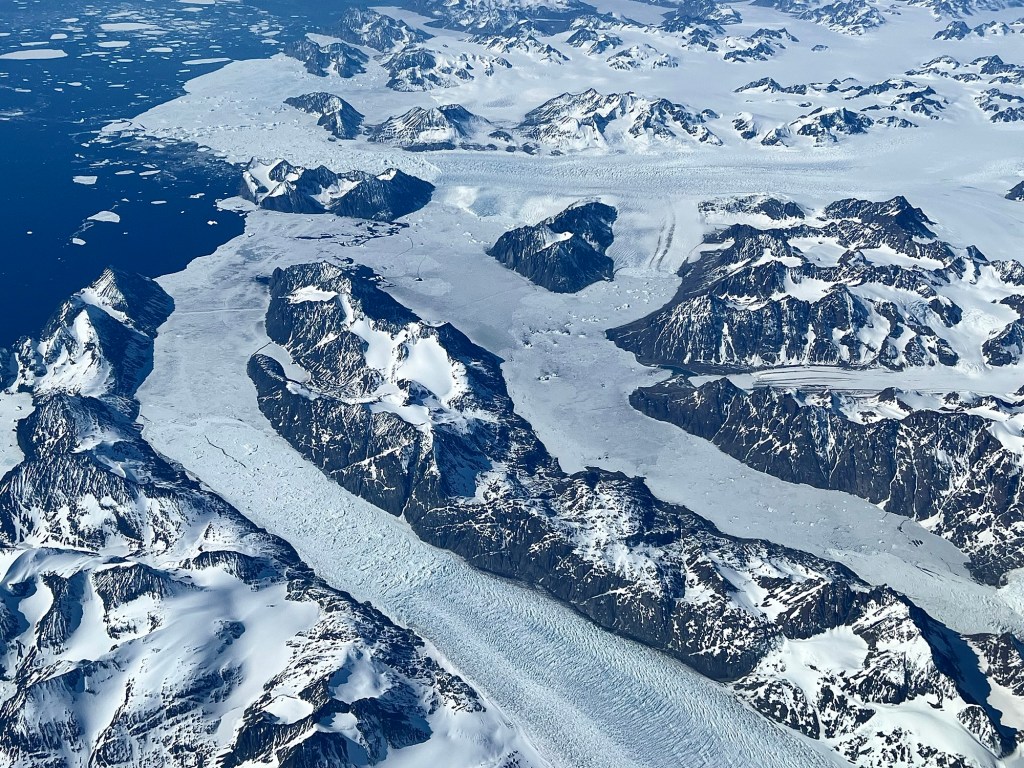
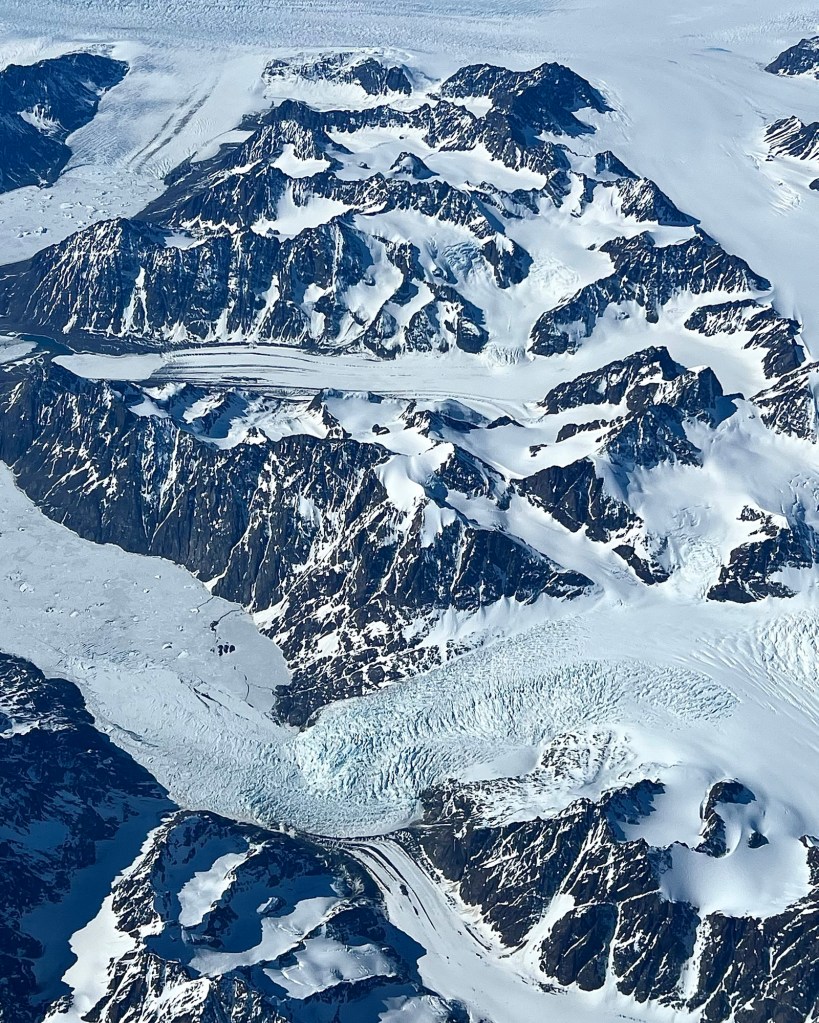
A view of some of Greenland’s glaciers.
Supposedly Trump is concerned about U.S. security but there is absolutely no support for this notion. The Danes and Greenlanders have a 1951 treaty with the U.S. which allows it wide latitude as to the use of Greenlandic territory for security purposes. Outright political control will not provide the U.S. with more security than it already has; as I’ve already noted, the U.S. currently has complete access to Greenland. So if access isn’t really the motivation here, then what is?
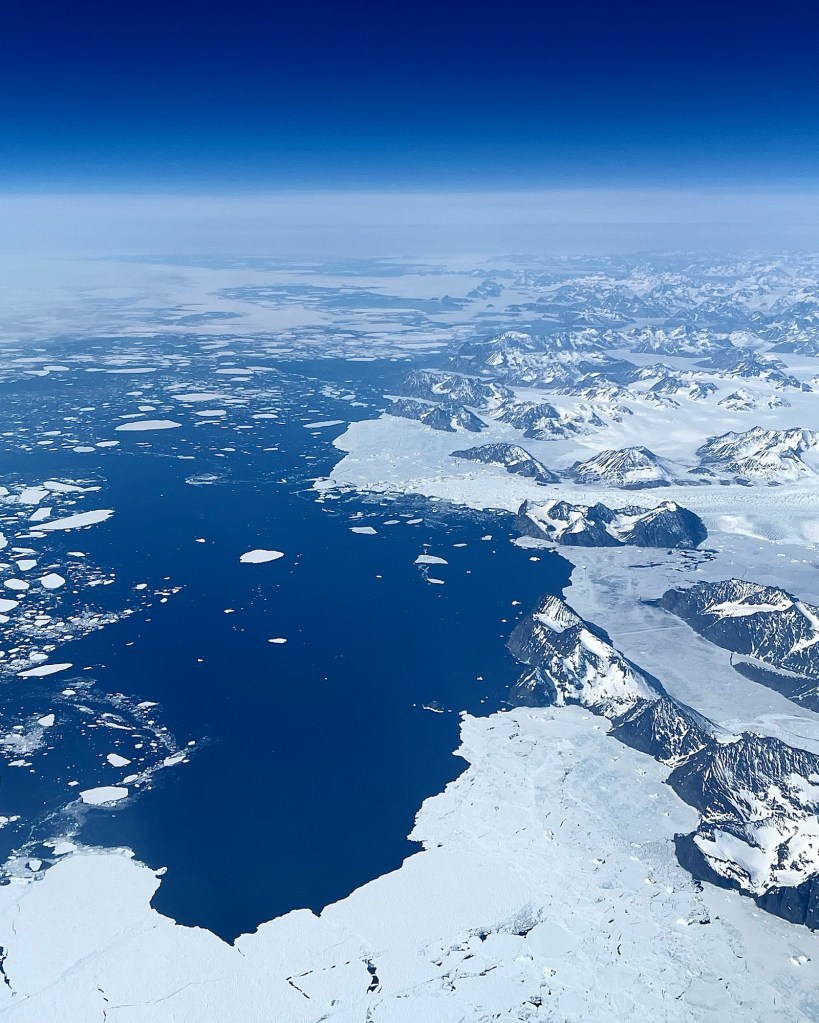
Ice pans in the Arctic Ocean near Greenland.
I think there are four possible reasons, some or all of which may be responsible for Trump’s obsession with Greenland: its mineral wealth; the fact that Trump wants the “western hemisphere” to himself; third, that he owes the Praxis outfit – and other significant donors – a place to develop their weird and almost Nazi-like technical state; and lastly, as he stated in his inaugural speech, territorial expansion. In other words, he wants Greenland to be part of his bulls**t self-aggrandising legacy. Trump has stated that “it will happen whether Greenland likes it or not” because “Greenland is covered with Russians and Chinese ships all over the place.” That latter statement is a verifiable falsehood; it’s just an excuse for Trump to steal a sovereign land for his own greed and ego.
Courtesy of David Parkins
These threats against Denmark and Greenland have further stoked the fears in other countries as well. Trump has repeatedly threatened to annex Canada or to bring us to our economic knees and force us into joining the U.S. Other nations are also rightfully concerned: Mexico, Columbia, Iceland, Panama … the list goes on. And now nordic countries are beginning to send troops to Greenland under the vague umbrella of military exercises and/or strengthening Arctic security but that also is beginning to look like a preparation against invasion.
I’m strongly reminded of Hitler’s theft of the Sudetenland in the run-up to World War II; he used the Sudetenland as a pretext for the eventual takeover of all of Czechoslovakia. An existential question for us then: if we Canadians do not stand up to help protect Greenland, who is going to help us when Trump decides that “it will happen whether [Canada] likes it or not?”
Greenland glaciers
The recent Vance/Rubio meeting with Danish and Greenlandic foreign ministers Rasmussen and Moltzfeldt went nowhere and Trump doubled down on his demands. The fact is that Trump has to be stopped before he goes any further. He is completely out of control with his threats against allies and enemies alike (is there a difference any more?), but to threaten a democratic nation that is also supposed to be a friend and an ally such as Denmark and its island of Greenland is a new low.
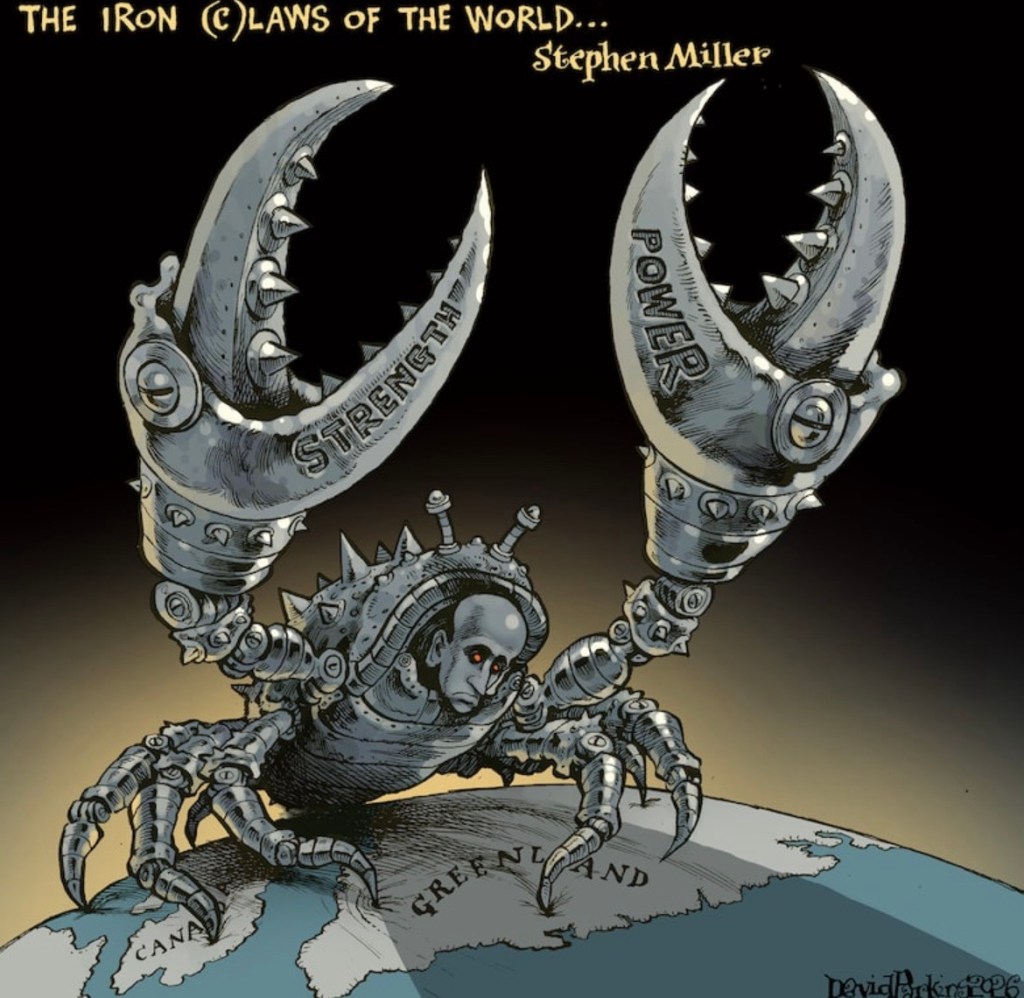
Trump sycophant Stephen Miller’s rant vis á vis the primitive notion regarding Greenland that might makes right is wrong, and it’s always wrong. Is this how the United States treats an old friend, an ally?? Is this how Trump carries out his election platform to remove the United States from involvement in wars??
Courtesy of David Parkins
There are only two ways that Trump’s aggressions against Greenland now can be irrevocably stopped before he worsens and we find ourselves likely headed into a major conflict of global proportions.
The first is for other Nordic countries, including Canada, to arm Greenland to the teeth with materiél and troops. The second is that the American people, regardless of politics, must make their overwhelming opposition (a new Reuters/Ipsos poll shows that only 17% of Americans approve of Trump’s efforts to annex Greenland) to this greed-driven scheme known.
Greenland
Standing up to Trump particularly through your representatives and most importantly, as your elections come up this year (a frightening thought making the rounds is that Trump might try to cancel them) is now more important than ever. At the very least, and for the sake of your country’s reputation, your voices need to be heard. That said, all of us need to do what we can to prevent Trump from going forward with this affront to democracy and self-determination.
While out for a ramble I heard a very distinctive sound: that unmistakable rattle of dry leaves in a gust of wind; there they were, swirling on the ground in a sure demonstration of the unstoppable arrival of autumn.
We’re still very green, but even those leaves seem to make that particular rattling sound once September arrives. It’s understandable. By turns it has been hot, dry, smoky, and windy. They’re tired.
But among all that greenery the autumnal colours are slowly creeping in. Everything in life starts small.
Although autumnal yellows are often the first colours to show, I’ve already noticed some reds, too.
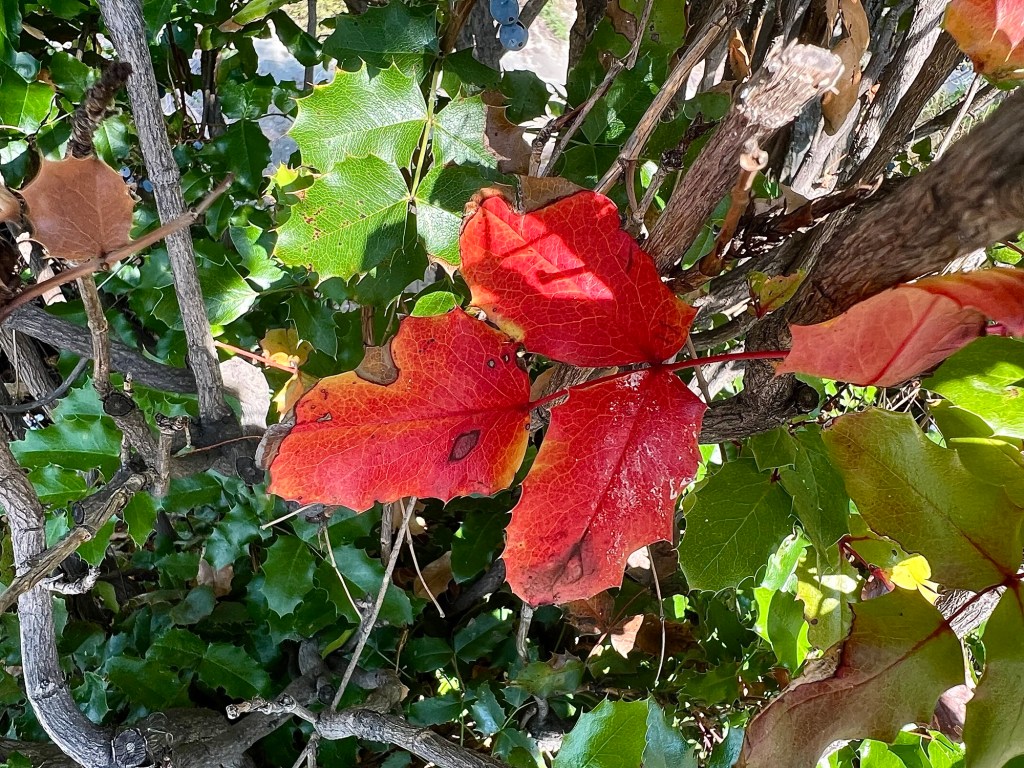
The Oregon grape is changing its dress …
… while the matador roses that bloom so beautifully and unceasingly from June through August, are beginning to slump.
Summer officially ends in less than two weeks and while it’s a bit sad to see it go, autumn is a wonderful season with its graceful and stunningly beautiful characteristics. I’m looking forward to it.
The following is an opinion piece by columnist Andrew Coyne originally published in The Globe and Mail on August 29, 2025. Given Donald Trump’s behaviour and the unwillingness or inability of those around him, including Congress, to exert some control over him, the issues and questions that Coyne raises in this article are particularly germane, especially in light of Trump’s continued threats against our sovereignty and our right to exist as a country.
Donald Trump is on the brink of becoming a dictator. Can he be stopped?
~ by Andrew Coyne
Donald Trump’s giant portrait hangs on the Labour Department headquarters near the Capitol in Washington, on Monday. (Associated Press)
By now it should be clear that the subjection of the United States to the dictatorship of Donald Trump is no longer a theoretical possibility or even a distant probability. It is an imminent reality.
It is not here, quite – critics of the President remain at large, the courts are still attempting to enforce the rule of law, the results of the 2026 and 2028 elections have not yet been determined – but the pieces are being put in place at astonishing speed.
To call what is happening a “slide” into authoritarianism, as if it were something anarchic and uncontrolled, would not be apt. It is more like a cementing. Having slipped back into power by the narrowest of margins, Mr. Trump and his acolytes have been steadily expanding from that beachhead, each new power serving as the means to acquire still more.
Often these powers have been acquired illegally, in brazen defiance of the Constitution. But so long as no one holds them to account for it, and so long as the administration refuses to be held to account, they become ratified by convention, or practice, or sheer nerve, the de facto rapidly congealing into the de jure.
At some point, American democracy will find it is caught, immovably, a colossus in quicksand. The question is whether it has reached that point, or, if it has not reached it yet, whether it can still avoid doing so.
The examples pile up by the day. In recent days, weeks and months, Mr. Trump and his officials have:
Installed National Guard troops and other military forces in the centre of major American cities, first Los Angeles, then Washington, and soon (if Mr. Trump’s threats are to be believed) Chicago, Baltimore and New York, under the guise of fighting crime. Some of the guardsmen are armed; some have been conducting arrests, for which they have neither training nor authority. The D.C. police force was likewise taken under federal control. • Seized thousands of suspected illegal immigrants off the streets, the snatchings carried out by masked Immigration and Customs Enforcement (ICE) agents without badges, their victims bundled into cars without markings, to be sent in some cases to barbaric foreign prison camps, in some cases to their domestic counterparts, without trial, without even charges. ICE is increasingly seen as Mr. Trump’s personal police force. • Initiated criminal investigations into various of Mr. Trump’s antagonists, from Letitia James, the Attorney-General of New York who prosecuted him for fraud, to Jack Smith, the special counsel who prosecuted him for his attempts to overturn the 2020 election and for his handling of classified documents at Mar-a-Lago, to John Bolton, his own former national security adviser who has since become one of his severest critics, to Adam Schiff, the Democratic Senator and lead manager on his first impeachment, to Lisa Cook, the Federal Reserve governor who stands in the way of his desired takeover of the U.S. central bank. • Fired or demoted police officers and prosecutors responsible for bringing the Jan. 6 rioters to justice, having earlier issued a blanket pardon for the rioters themselves. • Threatened television networks whose programs or performers irritated him with suspension of their licences, or adverse regulatory rulings. • Extorted massive settlements from the same networks, or law firms who had acted for his antagonists, or universities he deemed too liberal, or even corporations, like Intel, he fancied a piece of. • Demanded Texas, Florida, Indiana and other states redraw their electoral maps, in a transparent attempt to gerrymander more Republican districts into being in time for the midterm elections; at the same time, Mr. Trump talks openly of banning mail-in ballots, while issuing executive orders demanding “proof of citizenship” for voting and requiring federal review of state electoral rolls. • Fired the head of the Bureau of Labour Statistics for issuing unemployment numbers that displeased him; fired the head of the Defence Intelligence Agency for issuing after-action reports on the U.S. bombing of Iran that likewise disagreed with Trumpian dogma. • Defied court orders with regard to various of the above. • Defied Congress with regard to the spending of money for the purposes for which it was appropriated by Congress, while imposing tariffs that must constitutionally be approved by Congress. • Issued a series of executive orders for which he has likewise no constitutional authority. As if to give visible signs of his intent, Mr. Trump has been furnishing himself with various of the accoutrements of a dictator, from the giant portraits that now hang on government buildings, to the gold-encrusted palace that was once the White House, to the military parade on his birthday, to the endless public displays of sycophancy he requires of his cabinet members. Indeed, he has taken in recent days to musing about dictatorship as a possibility – “a lot of people are saying ‘Maybe we need a dictator’” – as if he were not just trying out the description with the public, but habituating them to it.
Indeed, the portents are ominous. Commit violence on Mr. Trump’s behalf, and he will see that you suffer no penalty. Attempt to stop or prevent it, and he will have you fired or prosecuted. Criticize him, or represent his critics in court, and he will lean on the organization that employs you.
Think the courts will save you? He has stacked many of them, intimidated others, and will have no hesitation in ignoring those that remain. You can see him lining up a test case for the ultimate act of revolutionary disobedience, defying a Supreme Court ruling – maybe over tariffs, or illegal immigrants – and with it finally dispatching with the rule of law altogether.
Certainly he need have no worry about his own personal legal liability: the Court has already found that he is immune from prosecution, at least for acts committed in his “official capacity.” But who would even attempt to bring him to justice? The senior levels of the Department of Justice are filled with political allies or his personal lawyers. The Congress? But both houses are controlled, narrowly, by the Republicans, and while Congresses in the past have been willing to face down a President of their own party, the current GOP is made up of individuals who either share his dictatorial world view or are too frightened of him, and even more of his followers, to stand up to him. That is only likely to grow in line with his powers.
Ah, but there are next year’s midterm elections. Mr. Trump’s approval rating is mired in the high-30s. The Senate may be out of reach, but surely the Democrats can retake the House. Then the process of reeling in Mr. Trump can begin.
But you haven’t been paying attention. What do you think all that gerrymandering is about? Why do you think Trump is ranting about mail-in ballots? What else do you suppose is being arranged at the state level, out of reach of the national media? The chances of a free and fair election in 2026 must be rated at 50-50 at best.
Suppose the Democrats do retake the House. How do they enforce their will on a President who does not recognize the legitimate authority of Congress? By appealing to the Supreme Court? But we know Mr. Trump’s view of the rule of law. How many divisions does the Supreme Court have?
And as you ponder all this, remember: It’s only going to get worse. We are still in the very early days of this presidency. Mr. Trump’s behaviour has grown steadily more outlandish throughout, trashing norms and stepping over boundaries previously considered inviolable even by him. How much more outlandish is it likely to get between now and January, 2029, when Mr. Trump’s term is supposed to end?
Emphasis on: supposed to. As others have observed, Mr. Trump has not been carrying on like someone who expects to leave office in three-and-a-bit years. (That US$200-million ballroom he is building off the White House – or perhaps the White House is off it – is a clue.) He seems entirely unconcerned by the political opposition his actions have aroused, except to revel in the possibilities for repression they open up.
So 2028 rolls around. Maybe Mr. Trump runs again, as he sometimes muses, in violation of the U.S. Constitution. Or maybe he doesn’t. Maybe the election is free and fair, or maybe it isn’t. Maybe he just stays on, indefinitely. But whatever happens, how exactly is Mr. Trump to be removed from the White House? I mean physically.
By that time he will have replaced the entire command structure of the military with his loyalists. And of the intelligence agencies. And of the FBI. D.C. will have been under martial law for three years. Who, or what, is going to arrest him?
If this sounds over the top, then again you have not been paying attention. Everything Mr. Trump does defies belief, let alone precedent. Mr. Trump’s dash for dictatorship is rapidly approaching the point of no return. So the question that has always hovered in the air is now the urgent question of the hour: How can he be stopped – before it is too late?
That Mr. Trump is bent on making himself dictator is no longer in doubt. That he is well on his way to doing so should not be. If democracy in America is to be saved, its defenders must pour all their thought and energy into devising creative ways to frustrate his ambitions. Because they are running out of options, and out of time.
The Labour Day holiday originated in Canada in 1872 after a prolonged fight for the right to formally organise began with the Toronto Typographical Union who were striking to limit the working day to eight hours. This directly lead to the development of the federal Trade Unions Act, legislation that confirmed the legality of unions and formalised the rules for their place.
Ten years later, the Canadian trade union parades that brought attention to the need for good working conditions were noted in the United States and the United Kingdom, leading to those countries’ own formalised labour movements. The U.K. had trade unions as early as 1717, but they were declared illegal and getting them recognised and organised was a struggle that lasted until the late 19th century.
In 1894, Labour Day became a statutory public holiday in Canada marked for the first Monday in September. Since then, it has become somewhat unmoored from its “fair labour practice” roots and tied more closely to other traditions.
In North America, it’s the last long weekend of summer; for many, September 2 is the first day of classes for the new academic year. Between trying to enjoy a last bit of time off and getting students ready to return to school or uni, it can be very busy.
In Canada it’s the start of Canadian League football and traditionally was also the point at which you were no longer supposed to wear white – a practice that is no longer with us, I’m happy to say. Many also see it as a firm but unofficial end to summer fun and relaxation and the start of getting back at the job of serious work. No more summer hours!
Although its connection to labour unions may have seriously weakened over the years, Labour Day itself and the fact that it exists as a holiday represents the determination, focus and struggle of those early organisers who fought to ensure the beginnings of the fair labour practices and standards we enjoy today.
… and it’s been an interesting year. Our sovereignty is constantly being challenged by Mad King Donnie …
… who is punishing us with tariffs and anything else he can dream up to try to force us to capitulate to him, while also lying, exaggerating and manipulating any and all information to communicate that we’re basically a hulking Godzilla of a nation just waiting to pounce on an unsuspecting and innocent little U.S.
So while the king to the south of us continues to consolidate his power by stomping on civil rights, threatening and taking revenge on opponents, universities, courts and newspapers and rewarding his wealthy oligarch friends while seemingly bent on devolving his country into a chunk of geography without law, order or structure apart from whatever reflects his own weird image, we’re becoming more and more angry.
Once our federal election was over at the end of April, things had sort of cooled off for a bit. Trump came along to Canada for the G7 meeting with the other leaders last month and although he had to talk incessantly and inanely before the cameras, things seemed to go well enough.
Then our Prime Minister went to the NATO meeting in Europe, was interviewed by CNN’s Christiane Amanpour, had the effrontery to state that he thought Trump’s annexation talk might be over, and boom, there it was again. No one’s going to tell Mad King Donnie what he thinks, including him.
So, this Canada Day, we should focus on what we know is good about us. And I’m not talking about crap like beavers, poutine, hockey, maple syrup, snow, fleurs-de-lys, and excessive politeness. Those are stereotypes.
Nope, I’m talking about those things that make us who we are: an understanding of the world that allows us to comprehend ourselves and our place within in it, directly and without artifice. An ability to hear people as they are, even if they’re talking complete nonsense through their butts – and yes, sometimes those butts belong to our own people.
A capacity to face our insecurities – and we definitely have them – by realistically confronting them and dealing with them, sometimes through self-deprecation and sometimes through sincere humility, even if we haven’t solved them. An awareness of how important it is not to take ourselves too seriously combined with an attitude of live and let live and helping out when we can. I think most of us love that about us. We’ll tolerate a lot … right up to where whatever it is starts stepping on our toes, and then we get pissed.
A Canadian 9/11 story narrated by Tom Brokaw – a story that most Americans don’t know.
We are not the best, the biggest, the brightest, the toughest, the strongest or really, any other est. For that matter, neither is any other country, including our neighbour to the south. We’re all just varying degrees of whatever we are. But for the most part we Canadians have a good grip on what it means to just live a decent life, to give or share what we have when it’s needed, to try to understand the new and to accept it even if we don’t.
Are we perfect? Absolutely not. For starters, we can be lazy. We can be fractious, discontented and prone to squabbling and finger-pointing. And in the past, we treated our First Nations as completely and utterly worthless. We can be messy and sometimes chaotic but we always seem to find a path that works for us.
And that brings me right back to Donald Trump. In the struggle to preserve identity, people become seasoned, scarred, damaged, and in the process, changed and toughened. And that’s happening to us now.
While we try to ignore his name-calling, his bullying, his desire to stick a knife in us and twist it, and his pronouncements about how weak we are – or how difficult we are – depending on what lies he’s telling, we will not roll over into becoming the 51 state or more likely, a rights-less territory. And if he keeps pushing, there will come a time when what we’re learning will come into play.
So this Canada Day, it’s not about beavers and maple syrup or various actors, singers and sports figures who wear Order of Canada pins but haven’t lived in this country for years. It never was. At some point or other, we all face a personal Rubicon. As a nation, here’s ours. And we’re here, we’re us, we see ourselves, we know ourselves, and we don’t need to be – or want to be – anything else. 🇨🇦
I was (and still am) a big fan of Anthony Bourdain. I remember finding his first show, “A Cook’s Tour” on a minor travel channel and soon found myself completely hooked. I read all of his books and watched all of his shows as they came along.
Photo courtesy of Alex Welch, New York Times
I was raised in French-speaking Canada, learned to cook in the French country way, and I always felt, even from a very young age, that one of the best ways to understand a culture is to try its food. So when Anthony Bourdain came along, with his French name and food/travel attitude that aligned with mine, I thought yes, finally! Here’s someone who’s doing a thoughtful travelogue-and-food-as-cultural-identity show.
Icelandic salmon
My desire for travel was inspired by my childhood trips to my mother’s homeland, the UK. On one of these visits, she took me on a side-trip to Paris, and that’s where for me, food and travel merged and grew. Since then, and although I’ve now slowed down, I’ve travelled enormously and have always, first and foremost, accessed a region’s culture through its food.
The best seafood chowder ever; from a visit to Reykjavik.
Food is who we are. We depend on it not only for the practical purposes of sustenance, but also for comfort, warmth, remembrance, history and connection. Food brings us together, both in celebration and mourning, in romance and heartbreak, and very often, just as a pleasure in and of itself.
Many years ago, in a very small neighbourhood restaurant in an off-the-tourist path, outside-of-tourist season part of Venice (this was when actual Venetians still existed, before that marvellous city was more or less turned into a theme park), I was introduced to a wonderful rendition of linguine alle Vongole (linguine with clams). I wound up spending much of the afternoon chatting with the owner, he in his broken English and I in my very poor Italian, drinking local wine and learning more about Italian food – and Italians – than a dozen cook books could ever provide.
Mushroom pasta, one of my favourites.
And this is one of the best things that Anthony Bourdain shared with us: the idea that food is travel, and travel is food. It’s about connecting with the people who make the food, about why it’s an important part of their culture and by extension, why it is that we want those particular foods to become a part of ours. It’s mind opening.
A traditional favourite in my family: winter tourtière (meat pie).
It’s very sad that despite Bourdain’s reverence for travel, for food, for life, his was cut short by one of the very things he frequently discussed in his programs: the human condition. Our condition can be a complex, circuitous mystery, quite often particularly to ourselves. He was so ably conversant with it and at times showed such insight, but as it is for many of us, he clearly had a hard time dealing with his own condition.
A wonderful seafood pasta.
Regardless of the manner of his passing, he gifted us with an enormous body of work. Often irreverent and acerbic, sometimes scandalous but always passionate and honest, Anthony Bourdain communicated his observations and philosophy through the wonderful medium of food, a medium we can all understand, and I will always appreciate him for that.
After his passing, friends of his, Eric Ripert and José Andrés, started an unofficial Anthony Bourdain Day on June 25, his birthday (yes, I’m a day late). So if you’re inclined to honour him, his favourite drink was a negroni, and one of his favourite foods was pasta, and you can eat and drink in his memory.
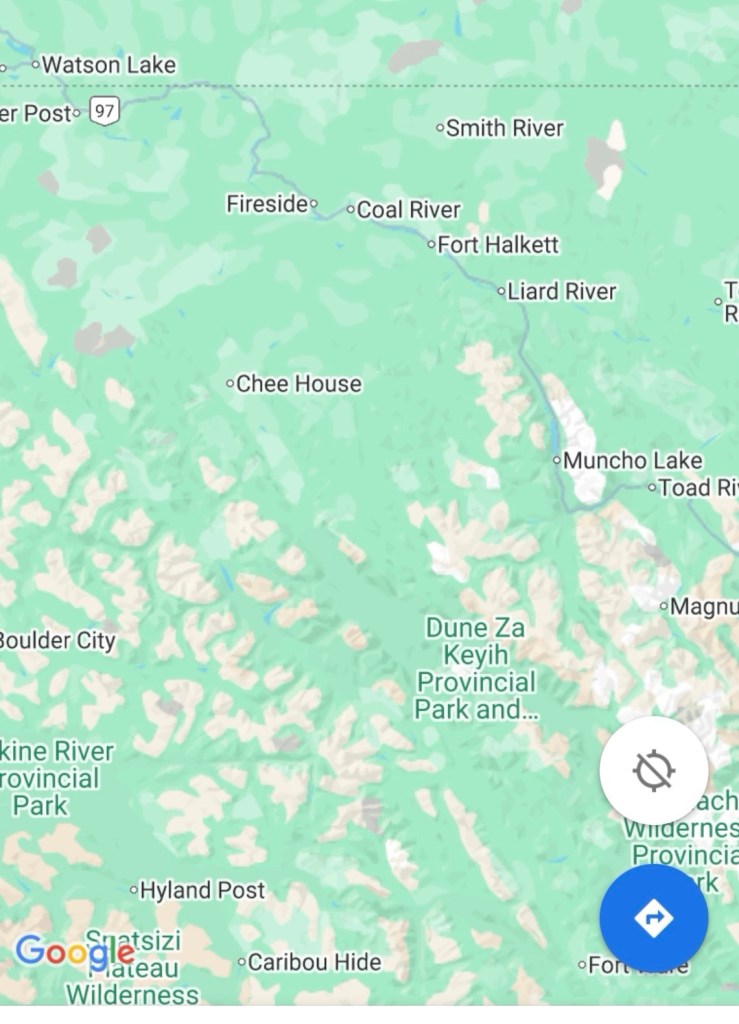
After we enjoyed the hot springs at Liard River, we stopped at Muncho Lake Lodge for the night. We had a great dinner and more fantastic views.
Amazingly crystal clear, Muncho Lake is a feast for the eyes. Can you tell if this photo is upside down or not?
Actually, it’s right side up; you can see some irregularities in the reflection if you look carefully. Nevertheless, that’s a fantastic mirror image of some of the Northern Rocky Mountains, isn’t it?
Muncho Lake, like many of the Rockies’ lakes, is green. Caused by glacial sediment, some lakes can also be various shades of cobalt blue interspersed with green. That green shade isn’t evident in the first picture because of the light’s angle refracting from the lake’s surface.
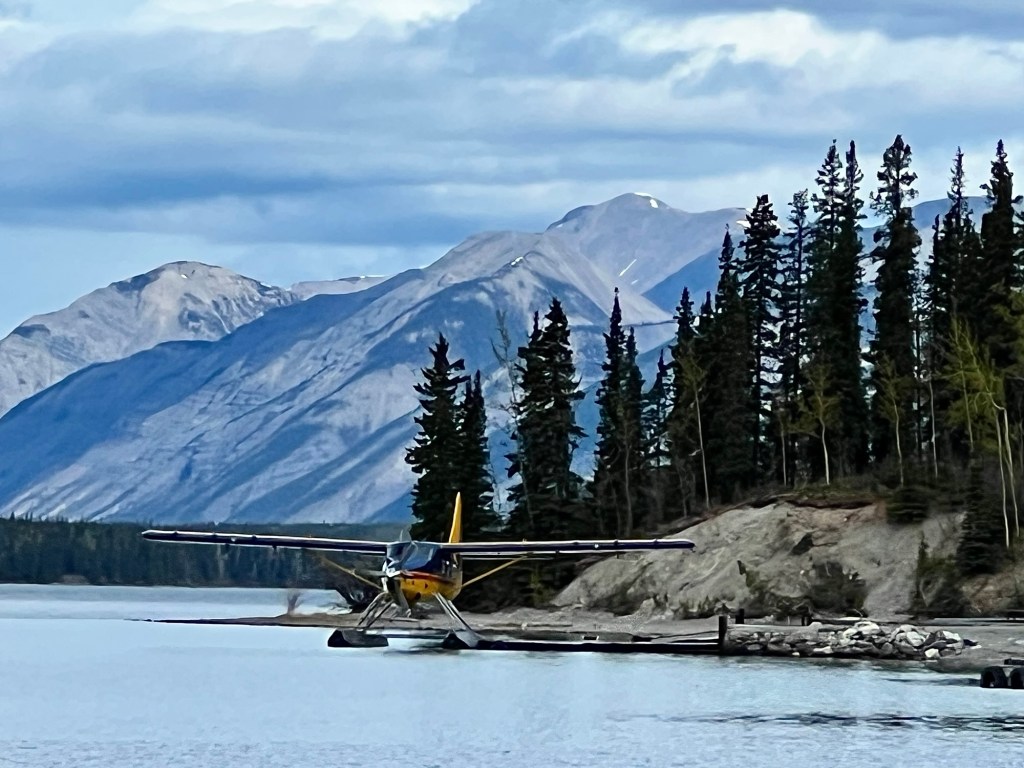
No photoshopping; no dye! It’s just green. A float plane parked at Muncho Lake Lodge; a fine piece of Canadiana.
The next day we stopped in Fort St. John, after having travelled much of the stunningly beautiful highway 97 (Alcan or Alaska Highway), so there is another post coming about the fantastic sights we were able to experience during that fantastic drive.
The Liard River is one of the more major rivers in northern British Columbia.
As we left Yukon and began to drive south on highway 97 (also known as the Alcan Highway or Alaska Highway), we paralleled it for some time before it made its way east.
Before that, however, we stopped at the Liard River hot springs for a dip. I was glad that we didn’t have far to go afterward because following that appealing break we were very, very relaxed!
On our way into the hot springs we saw loads of lovely wild violets.
Rugged and swift, the Liard River is a part of highway 97’s extremely scenic landscape and with the added bonus of lovely natural hot springs, our first day’s drive on this route was wonderful.
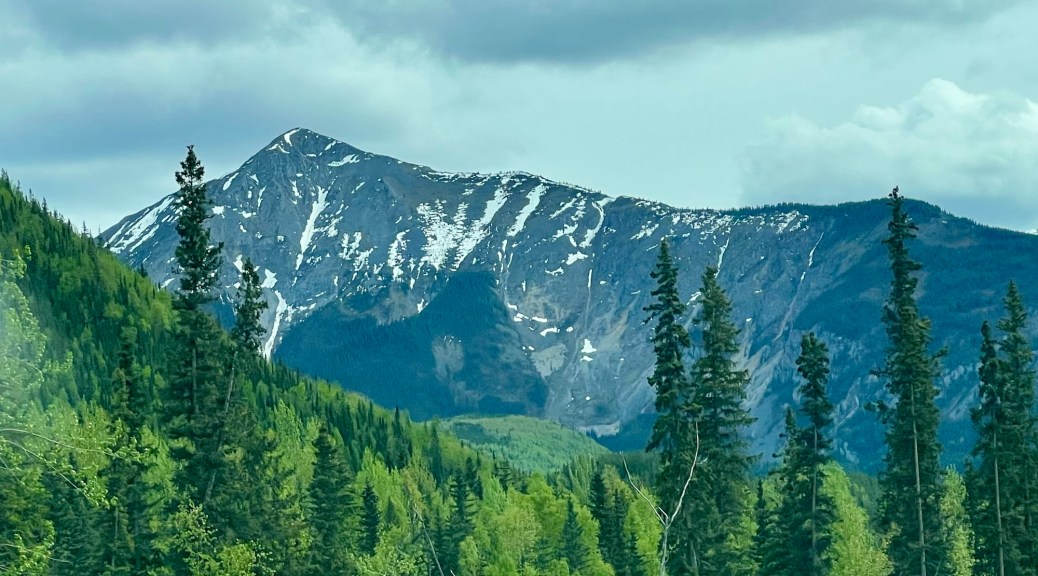
Northern Rocky Mountains
There’s more to come from this spectacularly gorgeous drive. I thought that the Stewart-Cassiar highway was at the top of the heap for beautiful drives, but highway 97 is right there, too!














 In the Net! - Pictures and Stories of Life