This post was first published in 2013; here it is again, 11 years later, in honour of the 80th anniversary of D-Day.

Canadian military during World War II D-Day Landings on Juno Beach (Photo credit: Globe and Mail).
The 69th anniversary of D-Day was on June 6th, last Thursday. Like so many, many others, my dad was one of those involved. He wound up going all the way to Hamburg, Germany, before “his war” was over and he was permanently sent back to England to my anxious mother, herself a member of the British army.
World War II and my parents’ participation in it shaped their lives; they and their cohort were subsequently referred to as the “Greatest Generation.”
How could it not shape their lives?
It has shaped ours, too; it’s just that we don’t register it much or perhaps give it as much prominence as it should probably have.
We lap up the sacrifice of our parents, grandparents and great-grandparents without understanding where it came from or even being aware that that’s what we are doing.
As my dad became older he often reminisced about his and my mother’s lives during the war. He talked about the time that they raced into an underground station in London seconds ahead of a bomb that tumbled down the steps behind them, following them.
They made it to relative safety before the bomb exploded; others did not.
My dad was also evacuated from Dunkirk.
The Dunkirk evacuation, the D-Day Landings and the Normandie invasion were, however, not something that my dad discussed until he was in his seventies. For him, outrunning a bomb was a story he could tell, but Normandie and Dunkirk? And later on, a concentration camp: the scope was too big; its effects were too broad. Compared to that, his personal experiences of it were tiny.
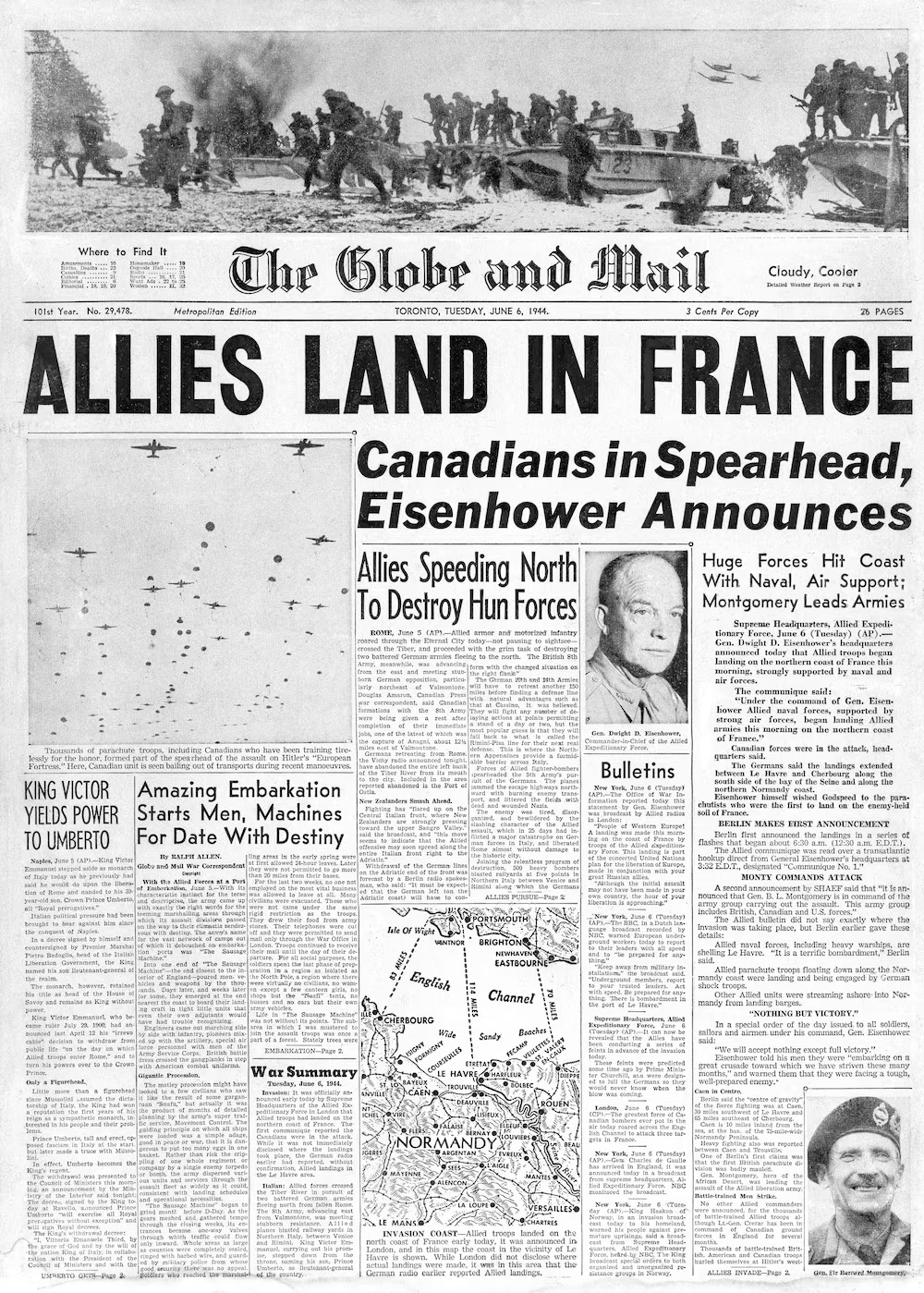
Photo courtesy of the Globe and Mail.
How do you get your mind around it?
The World War II veterans did not talk much about what they had endured. They just wanted to get back to their lives and enjoy the peace. But I also think that they may have had difficulty trying to communicate how massive this all was. The numbers of people, the equipment, the exhaustion, the death, the destruction, the genocidal madness. For the sake of one’s sanity, it has to move to the personal. This became obvious to me when I realised how difficult it was for my dad to return to England. My mother visited her homeland frequently, but my dad waited 30 years before returning.

Photo courtesy of the Globe and Mail.
No one person could tell it. Better to go home to try to forget.
They had earned the right to either talk about it or not, remember or not.
We children, grandchildren and great-grandchildren don’t have that choice, however. We have an obligation to remember.
We owe them a debt of gratitude that can only be re-paid by protecting and respecting what they won for us – our very selves, our freedoms, our many luxuries.
My dad is long gone now, as are most of the WW II veterans, but we can think about what they did for us.




 In the Net! - Pictures and Stories of Life