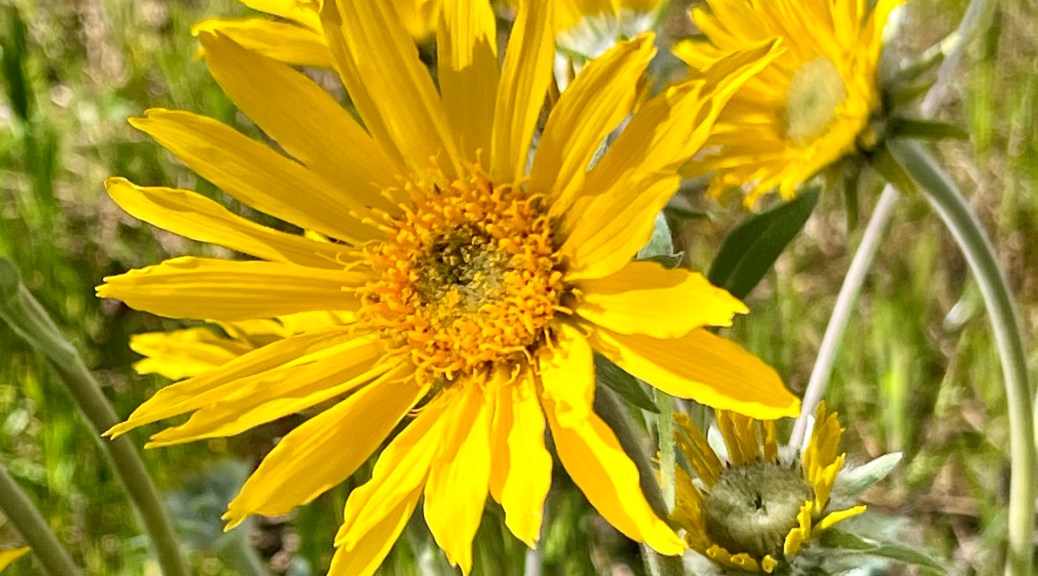
The Okanagan sunflowers are blooming!

Except these aren’t actually sunflowers at all. These are arrowleaf balsamroot plants, and they are entirely edible from their roots to their blooms.

They grow only in a limited number of pine forests in the Okanagan Valley and somewhat farther south as the valley extends into Washington state. They possibly grow elsewhere but in that case they would be transplants; the range of the arrowleaf balsamroot plant is limited to this area; they are uniquely adapted to this valley’s naturally dry conditions – this is geographically the northernmost tip of the Sonoran Desert – and with their extremely long taproots can find water deep underground.
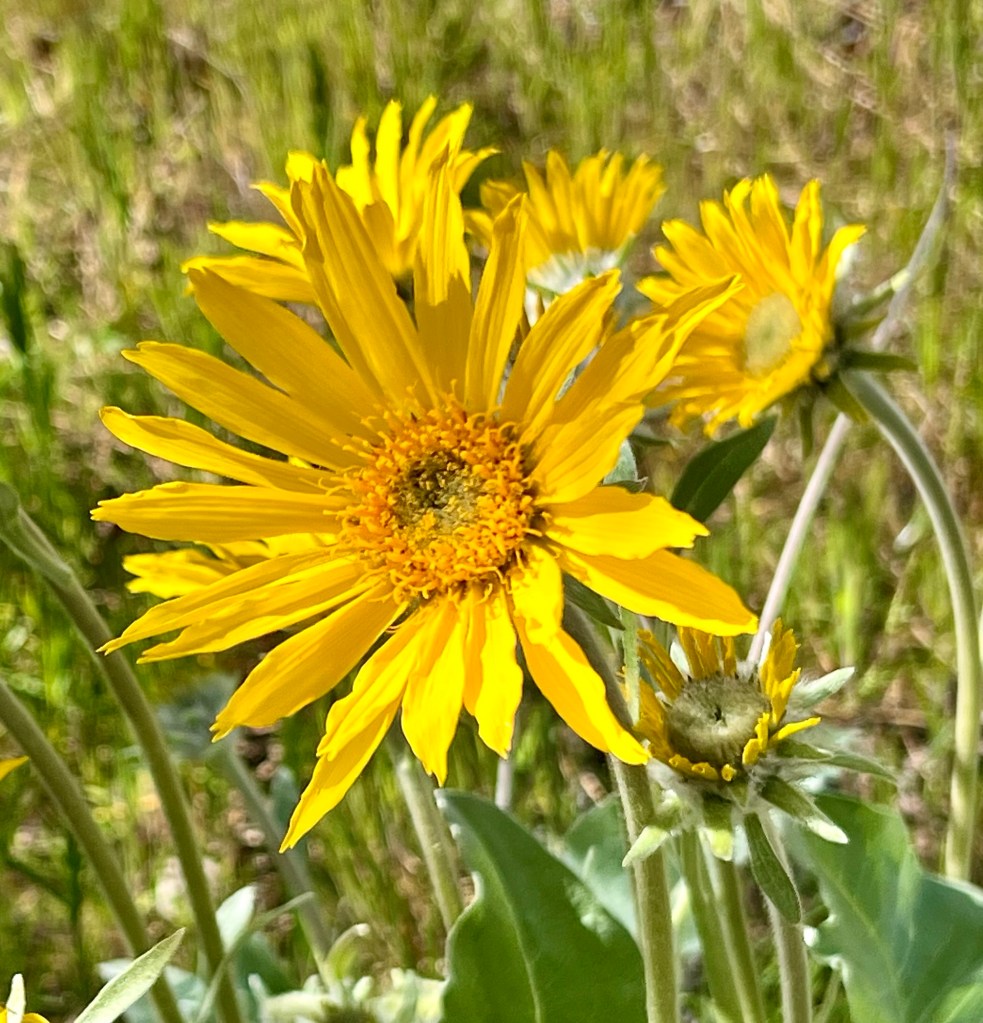
They were an important food source to First Nations peoples; the roots and seeds were ground for flour, and the leaves and stalks were steamed or consumed raw. This incredibly nutritious plant with its high degree of anti-inflammatory properties is now making a return to local kitchens and can be found on some restaurant menus.

Presently they are blooming profusely all over the hillsides and especially among the pine forests, brightly beautiful with their yellow faces, but they have to be enjoyed now as the blooms only last about a week.
To those to celebrate, Happy Easter and Happy Passover; to those who don’t, happy Sunday. 🌼
 In the Net! - Pictures and Stories of Life
Happy Easter, Lynette ❤️
LikeLiked by 2 people
Thank you very much, Phil and Michaela. 🐇❤️
LikeLiked by 1 person
Wonderful! Wishing you a happy Easter xx
LikeLiked by 2 people
Thank you very much, Jo. To you as well. 🌼
LikeLiked by 1 person
How interesting; particularly its anti inflammatory properties. Thanks for sharing, Lynette, and happy Easter!
LikeLiked by 1 person
Thank you very much, Tricia and you’re welcome. A couple of times I’ve seen people picking them but I’ve never tried them. Cheers.
LikeLiked by 1 person
Happy Easter, Lynette. I want to explore that hillside.🤩
LikeLiked by 1 person
And to you, Hazel. Right now there are many hillsides covered in these flowers. So pretty!
LikeLiked by 1 person
That sounds amazing, Lynette
LikeLiked by 1 person
😊
LikeLiked by 1 person
Gorgeous. Love the bright yellow. Happy Easter Lynette. Allan
LikeLiked by 1 person
Thank you, Allan, and to you and Patty. That bright yellow is always so energising; it has a real impact, I think. Cheers.
LikeLiked by 1 person
It really is a special flower, with such a small region and short season. Thanks for brightening up my Easter Sunday. Maggie
LikeLiked by 1 person
You’re very welcome, Maggie. Yes, this flower doesn’t last long and they all bloom at once, too. The hillsides in some places were covered with them. Very prolific but a short span. Cheers.
LikeLike
Happy Easter and Happy Sunday!
LikeLiked by 1 person
Thank you very much! To you, too. 😊
LikeLiked by 1 person
It’s so nice to have bright flowers early in the year.
LikeLiked by 1 person
It sure is, Anneli, and it helps that we have had a wet winter and spring, too. I looked at my photos from this time last year and everything was really so dry then. Much better this time, I think. Cheers.
LikeLiked by 1 person
Happy Easter. Do you find your yellow flowers peak early in the spring? Over here, we start with white and yellow dominating (primroses, cowslips and buttercups), before the meadows turn much pinker (orchids, knapweed). Pollinator preferences perhaps.
LikeLiked by 1 person
Good question, Adele. In thinking about it I would agree that many of our yellows peak in the spring. I can think of two exceptions – buttercups and sunflowers – that peak in late August. We have lots of pink spring flowers right now though, especially when the orchard flowers are added such as plums, cherries and apples. The lilacs are blooming now too and I’ve seen the bees happily buzzing around them.
LikeLiked by 1 person
So beautiful flower!! And nice to know that you can eat it 🙂 And Happy Easter.
LikeLiked by 1 person
Thank you very much. 😊 Yes, these are both beautiful and edible so very versatile!
LikeLiked by 1 person
They’re beautiful plants, for sure.
I’ve seen them a few times … while over in central Washington.
LikeLiked by 1 person
Yes, part of their range is through central Washington. Definitely beautiful and also very useful if necessary. Cheers.
LikeLiked by 1 person
We were there last spring when they were out, and they are stunning! I had no idea they were so medicinal.
LikeLiked by 1 person
I agree, Bernie. A hillside covered in these bright yellow flowers is stunning. Yes, apparently First Nations peoples used them extensively for their anti-inflammatory properties. They’re also very nutritional, so not just a pretty face!
LikeLike
Happy Easter!
(\_/)
( • .•)
/ >🥕
LikeLiked by 1 person
I love your bunny, Cindy. Happy Easter to you and yours. 🐇
LikeLike
Happy colourful Easter time!
LikeLiked by 1 person
And to you, Luisella! 🌸
LikeLiked by 1 person
Thank you.
LikeLiked by 1 person
Beautiful! Happy Easter!
LikeLiked by 1 person
Thank you very much, Cecelia. And to you, too. 🐇
LikeLike
What a delight 😊. Beautifully photographed, Lynette!
LikeLiked by 1 person
Thank you very much, Belinda. 😊 Cheers.
LikeLiked by 1 person
Hi Lynette, I had not known about these pretty yellow flowers. I’m always awed by how First Nations people made such great use of the natural world around them. Thank you for sharing this information.
LikeLiked by 1 person
You’re very welcome Barbara; my pleasure. They certainly knew a lot about the natural world, plant and animal biology in particular. We’re only now beginning to understand how much. Cheers.
LikeLike
Wow! Looks exactly like sunflowers.
LikeLiked by 1 person
There are some significant differences but yes, they do look like them. Cheers. 😊
LikeLiked by 1 person
Happy Easter to you too!🥰
LikeLiked by 1 person
Thank you very much. 😊
LikeLiked by 1 person
Such pretty yellow flowers. Interesting to hear that they are edible. Have you tried one?
LikeLiked by 1 person
I have tried a leaf. It tastes slightly grassy and lemony but has some bitterness too, like kale. It’s being served in some places in salads. I’ve never tried anything made with the flour, though. Cheers.
LikeLiked by 1 person