
We’ve recently had some rather spectacular cloud formations. Here’s one, an excellent example of a towering cumulonimbus that’s reflecting the setting sun.
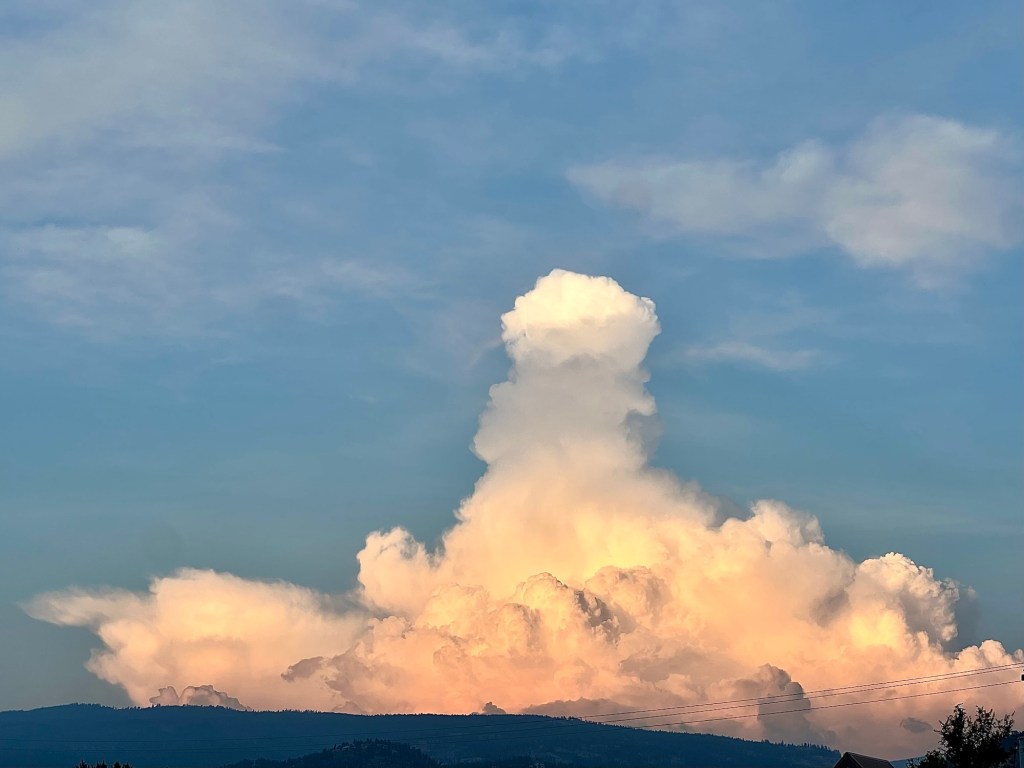
These clouds are known in aviation as “clouds of vertical development” and are extremely dangerous because they can contain hail, lightening, microbursts, wind shear and turbulence severe enough to break an aircraft apart, even a large commercial jet. Pilots are always very careful where vertical cloud development is concerned. These cloud types can also cause very dangerous thunderstorms and are precursors to tornadoes. Basically, a tornado is a towering cumulonimbus cloud gone absolutely wild.
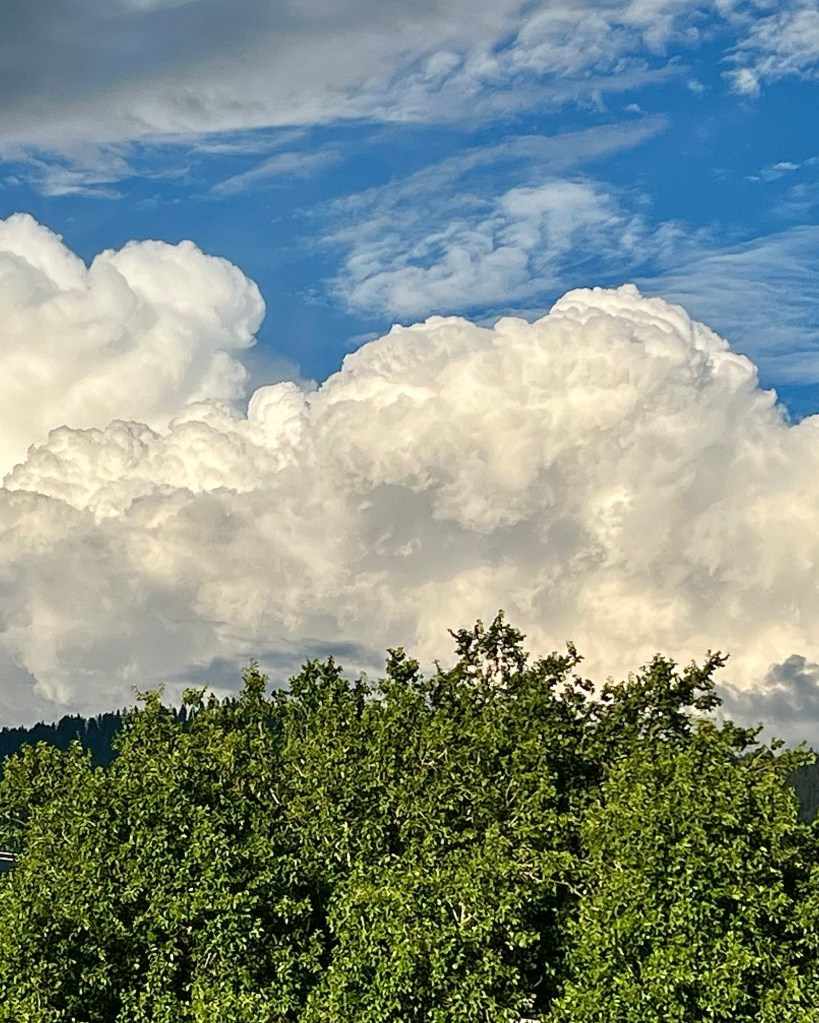
If you see a towering cumulonimbus and it’s headed your way, you should always be cautious, especially if you live on the prairies where the flat topography and lack of obstacles such as hills or mountains allows for unimpeded, potentially destructive development.

Otherwise, you can marvel at these natural constructions and enjoy their visual impact.
Happy Thursday.
 In the Net! - Pictures and Stories of Life
They are certainly eye-catching.
LikeLiked by 1 person
Yes, they definitely can be.
LikeLiked by 1 person
Thanks for your insight into these magnificent cloud formations Lynette. So beautiful but full of potential for destruction. Have a great Thursday. Allan
LikeLiked by 1 person
Thanks and you’re welcome, Allan. I was a member of search and rescue at the time of the Pine Lake tornado and was amazed at what it did. Embedded golf balls and a barbeque fork that went through the roof of a car and was sticking upright in the driver’s seat; the car itself had been tossed and its wheels were completely buried in the turf. Agreed, beautiful to watch as long as they keep to themselves.
LikeLiked by 1 person
I didn’t know any of this about towering cumulonimbus clouds. You did make it look very pretty too. 😊 Maggie
LikeLiked by 1 person
Thank you very much but that’s really just the way it looked. 😊 I think they’re gorgeous and we actually get some rather impressive ones here but they can’t develop fully because of the mountains. Cheers.
LikeLiked by 1 person
They are impressive looking and you’ve captured them very well! To be admired from a safe distance.
LikeLiked by 1 person
Thank you very much, Belinda.😊 We have a great view of them coming over the mountains from the east but the mountains also impede their development too which is a good thing!
LikeLiked by 1 person
Clouds tell us a lot about the weather.
LikeLiked by 1 person
They sure do, Anneli!
LikeLiked by 1 person
I think your flying experience is showing here, when flying through clouds it seems the aircraft is always getting bumped around which doesn’t bother me, Lynette. Clouds are beautiful!
LikeLiked by 1 person
Yes, it is. 😊 The puffy clouds usually carry some turbulence and you’re most likely to experience bumps on takeoff, climbing, descending and landing. At altitude, pilots will avoid turbulence as much as possible since it can make many passengers uncomfortable or even scared. Those clouds are definitely beautiful but also to be respected, too. Cheers.
LikeLiked by 1 person
Oh I respect the power of those clouds for sure! And the skilled people who fly the aircraft. Great people!
LikeLiked by 1 person
Thank you very much, John. 😊
LikeLiked by 1 person
You are welcome, Lynette. 😊
LikeLiked by 1 person
😊
LikeLike
Powerful clouds there and full of intensity. Great photos.
LikeLiked by 1 person
Thank you very much, Kerri. 😊 Yes, definitely powerful and intense.
LikeLiked by 1 person
😊🌻have a the best day ever!!
LikeLiked by 1 person
Thank you. 😊
LikeLiked by 1 person
It’s hard to believe an interesting looking cloud could be so dangerous. I learned something new today; thanks, Lynette!
LikeLiked by 1 person
You’re welcome, Tricia. 😊 Yes, these clouds should be respected, particularly when they develop on the prairies on hot days. They can really become menacing very quickly. Yes, beautiful but dangerous.
LikeLiked by 1 person
They are remarkable to see and I had no idea they were so dangerous to aircraft. Not seen those today but we’ve had a great display of flying saucer clouds…lenticular, is it?
LikeLiked by 1 person
Yes, those clouds are extremely dangerous and especially because they can develop so quickly and typically are much nearer the ground (potentially in the landing or takeoff path). I remember – to this day and word for word – my first flight instructor emphasising their danger over and over.
Before the built-in aircraft weather detection tech and the improvements in ground installation weather tech, commercial aircraft suffered a string of terrible accidents particularly from the 60s – 90s. There have been improvements in weather-resistant airframe construction as well. Nevertheless, these clouds are still incredibly dangerous and pilots do everything to avoid them.
Yes, the lenticular clouds are often shaped like flying saucers. They usually form near mountains and can be visually stunning. It’s another cloud type that pilots avoid, though!
LikeLiked by 2 people
These are amazing photos of the clouds. Living where e have tornadoes I know about dangerous clouds, but I had never thought of any being dangerous to aircraft. Thank you for sharing this information.
LikeLiked by 2 people
You’re very welcome, Mags. 😊 Clouds are almost like living beings; they definitely have their individual characteristics! Yes, this type of cloud can be quite dangerous both on the ground and in the air.
LikeLiked by 1 person
I have always believed that clouds house ancient spiritual beings. Some people think I’m a creep but you can’t explain how a vertical cloud can/do contain microbursts, turbulence as well as hail. That’s forces of nature not just science.
LikeLike
Maybe you’re right and they do. Nevertheless, science is comprised of natural forces. And yes, the microbursts, hail and turbulence that can develop inside a towering cumulonimbus cloud are in fact explained by the natural forces of science. Give it a Google. 😊
LikeLiked by 1 person
Well, can’t beg to differ from you👌🏽.
LikeLiked by 1 person
We get those clouds (cumulonimbus) a lot here in north Texas along with large hail, severe thunderstorms, rain bombs, flash floods, and tornadoes. Large hail destroyed our roof and cars that were left out twice, and a tornado destroyed our neighborhood in October 2019. A neighbor’s roof crashed into our chimney but luckily our house stood. It cost $50,000.00 to repair though. Since this has become more common our home insurance have sky rocketed.
Your photos are great!
LikeLiked by 1 person
Thank you very much, Thomas. 😊
The same things occur with regularity on the Canadian prairies but for the most part with less ferocity, I think. I used to live in Alberta and had hail damage to a couple of vehicles; broken windows and damaged roofs are also pretty common. Occasionally there are tornadoes that do some really terrible damage. I worked search and rescue on this one: https://en.wikipedia.org/wiki/Pine_Lake_tornado
Yes, my storm insurance escalated while I lived there, too. Flat topography can be so susceptible. A 50,000 repair job? Ugh. That’s awful. Here in this region of British Columbia it’s more about fire insurance!
LikeLiked by 1 person
The Pine :Lake Tornado sounds terrible (I read the wikipedia entry). It is great that you worked on search and rescue. North Texas is part of tornado alley and we get 137 tornadoes on average per year. Nobody died in our F3 tornado where I live, but hundreds of houses were flattened., and my father in law was injured when he was lifted by the wind and a flying marble table hit him. It was kind of a miracle that no one was killed. Our house wasn’t flattened but our roof and chimney was destroyed, and so was the fence, garage door, the wiring and piping in the attic and my grill flew off. The yard was covered in debris from other houses and broken trees. However, other similar tornadoes in Dallas has killed a lot of people.
LikeLiked by 1 person
It’s both amazing and frightening what these storms can do. It sounds as if your area was fortunate to escape any fatalities and your father-in-law was lucky! Being struck by a flying marble table and living to tell about it is incredible! Of course, Dallas is a dense city and those can suffer enormous damage and resulting fatalities even though the buildings themselves will tend to slow a tornado. It must have taken a long time to get your repairs and clean-up completely done. Wow.
The Pine Lake tornado caused a lot more fatalities because people went inside their trailers to escape what they thought was a thunderstorm, but the tornado picked up many of the trailers and dumped them in the lake. About half the deaths were caused by drowning. Other things I particularly noticed were the barbeque forks and golf balls. These became incredibly dangerous objects during the storm. A barbeque fork went through the roof of a car and was sticking upright in the driver’s seat; the car itself had been tossed and its wheels were completely buried in the turf. These storms are serious business, that’s for sure.
LikeLiked by 1 person
That unfortunately that makes sense. Trailers and tornadoes mean big trouble. People are so unprotected. I should say that our neighborhood in Dallas is suburban with houses and not many apartment buildings despite it being within the city of Dallas. The tornado struck in the evening at 9PM. Businesses were closed, and everyone was done walking their dogs but almost no one had gone to bed yet. So, when the alarm went off the vast majority of people sought shelter in a good spot in their house, and the houses were generally of good quality. Hundreds of houses were demolished but people in them were mostly fine. But the damage was expensive 1.5 billion dollars. A very similar thing happened a few years before, also F3, also covering roughly the same area, but in a less wealthy neighborhood and 12 people died.
One thing that I thought was especially amazing was that the veterinary clinic (that we used) was totally destroyed, but on that night, there were no animals who stayed overnight. I should say NBC interviewed me about the tornado. I am at 1 minute and 10 seconds.
LikeLiked by 1 person
Thanks for including your interview! It’s nice to put a face and voice to a name! It’s so great that most people are prepared with safe places to wait out the storm. Houses can be replaced but not people.
That storm was gigantic! It’s really a wonder that people weren’t killed by it. Sometimes things just work out, don’t they? That seems to be the case with your veterinary clinic.
I’m surprised that with all that damage your storm repairs and clean up didn’t qualify for Fifer [?] (I don’t really know what that is but assume it’s a U.S. or state government aide or disaster insurance program?). Here, federal (and provincial) help would be automatic and assumed, but then again that’s another reason why our taxes are higher than yours.
LikeLiked by 1 person
Maybe you are right. Our Home Insurance is bigger instead (and it keeps rising). At least we do not have a lot of widlfires, like you do. That’s a much bigger nightmare. NBC called me out of the blue after finding my Leonberger blog. I’ve posted a few times about the tornado. They said they wanted my photos and interview me. Here is an example of one of my posts.
LikeLiked by 1 person
The forest fires are a recent phenomenon caused (most people here are convinced of this) by climate change, but yes, they are costly in so many, many ways. Our huge tracts of forest lands act as a catalyst against pollution and now all the smoke is contributing to pollution. It’s so heartbreaking. We now have a reciprocal agreement with Australia for fire fighting services as they’re another country that’s burning. They come here during their winters and we go there during ours. Alaska and your other northern states also had (and continue to have) many terrible fires this year.
I read your post (for some reason it wouldn’t let me leave a like). Your pictures definitely tell the story and remind me of the devastation I saw at Pine Lake. I am former combat military and I can certain confirm that I have seen combat zones with less damage than you suffered. Brutal!
LikeLiked by 1 person
I am a lot more scared of wildfires than tornadoes even though it is not our biggest problem here (yet). You have a much bigger problem. I know you and your neighbors are correct about the wildfires getting worse in north America due to climate change. In some parts of the world the wildfires are not getting worse. On the contrary, less likely due to more humid air, such as in subsaharan Africa. However, in places with dry condition to begin with, it is getting dryer and hotter. So yes you and western USA is getting worse wildfires due to climate change, according to studies by multiple universities and agencies including NASA and NOAA. I’ve posted about this here, if you are interested.
LikeLiked by 1 person
Thank you very much, Thomas. I remember your excellent piece and commented on it at the time. The North is warming and melting (north of 60° n latitude) at an extremely distressing rate. I lived there for six years until mid-2023 and saw spring arrive earlier and earlier with drier and hotter summer conditions each year. The snow was still arriving right on time and still dropping about the same amount of moisture but the sudden spring heating was melting the snow pack so quickly that it was just running off (the ground was still frozen) and not adding to the water table. As a result the huge fires – usually caused by lightning – have started there as well as in Alaska. So unfortunately it’s not just places that tend to be naturally dry that are getting hit by fire.
I’m not sure if tornadoes or fires are worse. At least the tornadoes pass through and that’s that. Fires can be so difficult to eradicate and can even continue smouldering underground throughout the winter. So terrible. And yes, in some regions fire has been reduced. I’ve read that concern in those places is now turning to flooding. We humans (as usual) have caused such a disastrous mess.
LikeLiked by 1 person
Yes, now when you say it, I remember, and it was a very interesting and informative comment. I should say that I am originally from northern Sweden and part of northern Sweden is north of the arctic circle (above 66 degrees) and even though I am not from north of the arctic circle (63+ degrees) I travel around there. The retreating glaciers, the shorter snow seasons, the warmer summers, the reindeers going crazy as well as wildfires we didn’t use to have are things that are quite noticeable.
Like I said, my opinion is that wildfires are worse. They are incredibly destructive. We don’t have a lot of wildfires here, at least not close to Dallas, but like you say, “tornadoes pass through and that’s that”. Wildfires scare me a lot more and one reason our home insurance has gone up is allegedly because the insurance companies no longer think that a wildfire hitting Dallas is no longer out of the question.
LikeLiked by 1 person
Yes, I remember that you are from Sweden but I wasn’t aware that you are from the northern Sweden. Yes, the changes in the North are extreme. I lived at 62.45° but worked all over the Northwest Territories including as far north as Sachs Harbour (71.9°). The further north I went in spring the more evident climate change became.
Wow, the insurance companies are upping your insurance because a forest fire could happen even though (I’m assuming) there isn’t a history of them in your region? After the fires in this region over a four-year period (many houses are built in the mountain forests) home insurance costs then soared, but not beforehand. The province has now placed a moratorium on forest home builds because the fire risk is too high.
LikeLiked by 1 person
About the insurance. Many Texas politicians may not believe in climate change, or at least they pretend that they don’t, but insurance companies sure do. They know what’s coming and are adjusting their rates.
LikeLiked by 1 person
Good point! They always know which way the wind is blowing (so to speak).
LikeLiked by 1 person
Thanks for the great cloud photos, Lynette.
LikeLiked by 1 person
You’re very welcome, Allan. Cheers.
LikeLiked by 1 person
Beautiful captures of the towering cumulonimbus clouds. It looks even more impressive from the colours of the sunset. Funny how something so pretty could be so dangerous.
LikeLiked by 1 person
The sun was shining on that cloud so beautifully as the centre pillar started to rapidly climb. It was quite amazing to watch in between getting some photos. Agreed, Linda. They are strikingly beautiful but dangerous.
LikeLiked by 1 person
Of all these photos, I am struck by the second to last with the three layers of colours.
LikeLiked by 3 people
Thank you very much, Geoff. I like it for the same reason. Cheers.
LikeLike