Greenland is part of the democratic Kingdom of Denmark and as such, is part of a sovereign nation that is also a member state of the European Union and NATO. I have visited Greenland several times; its people are friendly, peaceful, tolerant and harmonious. But now because of the greed of one man and his gang of thug-puppets, these peace-loving people are under serious threat. They are scared and worried that their democratic right to choose their own destiny is about to be stolen from them.
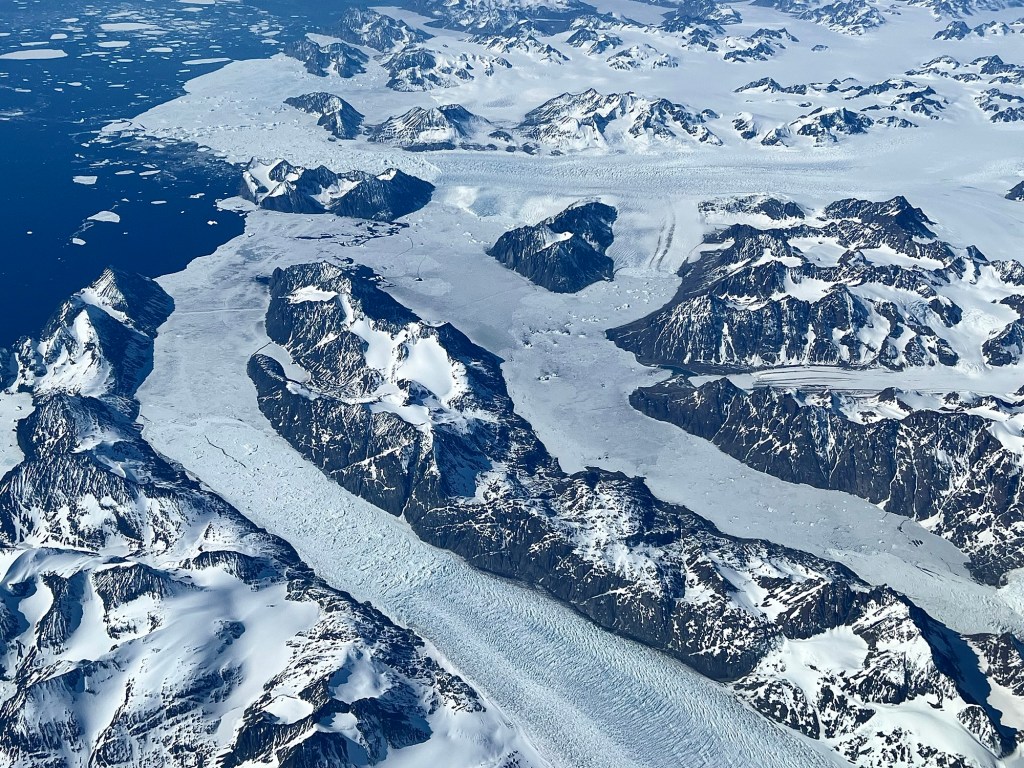
A view of some of Greenland’s glaciers.
Supposedly Trump is concerned about U.S. security but there is absolutely no support for this notion. The Danes and Greenlanders have a 1951 treaty with the U.S. which allows it wide latitude as to the use of Greenlandic territory for security purposes. Outright political control will not provide the U.S. with more security than it already has; as I’ve already noted, the U.S. currently has complete access to Greenland. So if access isn’t really the motivation here, then what is?
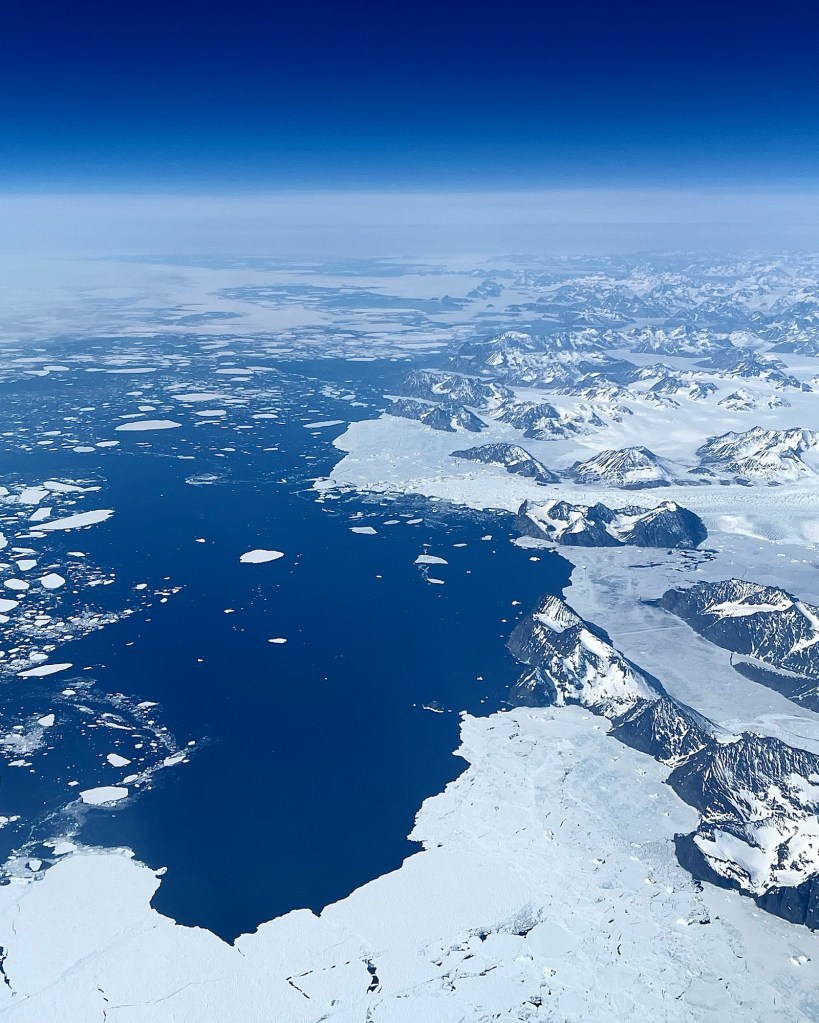
Ice pans in the Arctic Ocean near Greenland.
I think there are four possible reasons, some or all of which may be responsible for Trump’s obsession with Greenland: its mineral wealth; the fact that Trump wants the “western hemisphere” to himself; third, that he owes the Praxis outfit – and other significant donors – a place to develop their weird and almost Nazi-like technical state; and lastly, as he stated in his inaugural speech, territorial expansion. In other words, he wants Greenland to be part of his bulls**t self-aggrandising legacy. Trump has stated that “it will happen whether Greenland likes it or not” because “Greenland is covered with Russians and Chinese ships all over the place.” That latter statement is a verifiable falsehood; it’s just an excuse for Trump to steal a sovereign land for his own greed and ego.
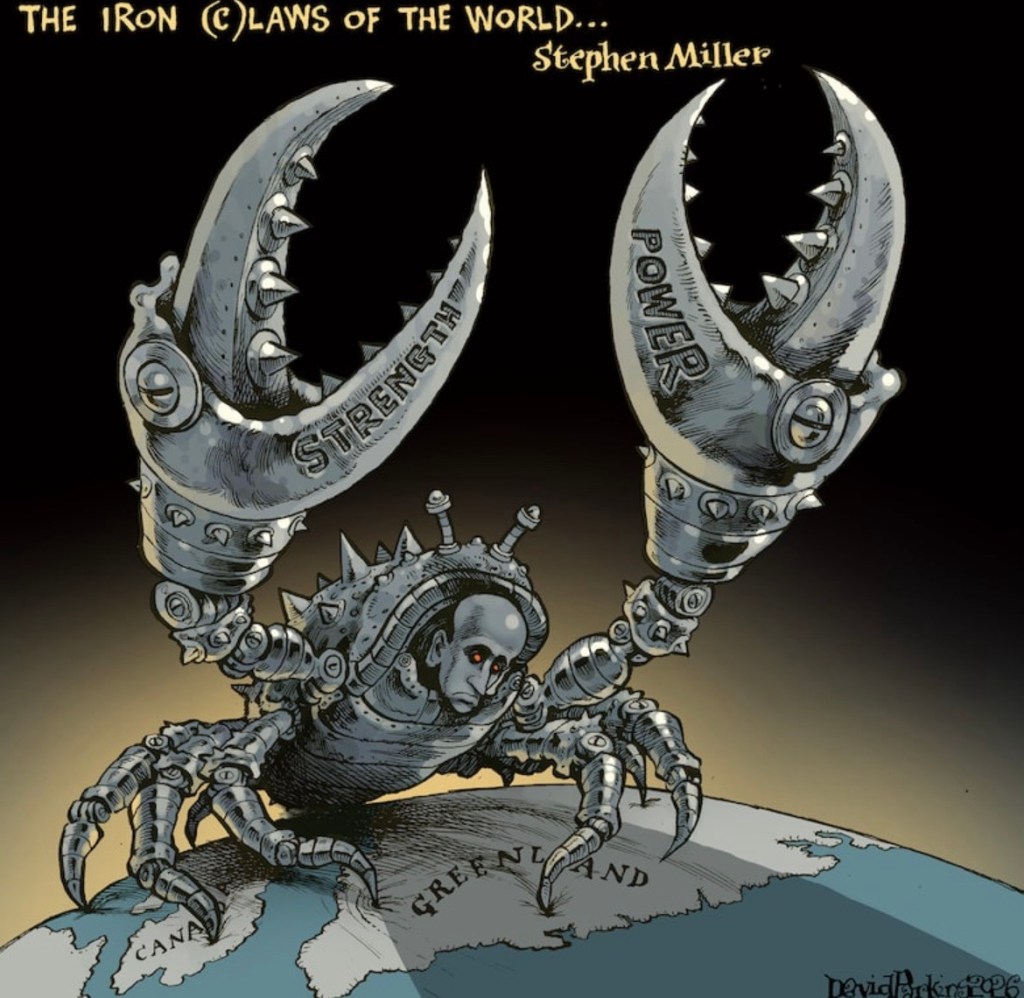
Courtesy of David Parkins
These threats against Denmark and Greenland have further stoked the fears in other countries as well. Trump has repeatedly threatened to annex Canada or to bring us to our economic knees and force us into joining the U.S. Other nations are also rightfully concerned: Mexico, Columbia, Iceland, Panama … the list goes on. And now nordic countries are beginning to send troops to Greenland under the vague umbrella of military exercises and/or strengthening Arctic security but that also is beginning to look like a preparation against invasion.
I’m strongly reminded of Hitler’s theft of the Sudetenland in the run-up to World War II; he used the Sudetenland as a pretext for the eventual takeover of all of Czechoslovakia. An existential question for us then: if we Canadians do not stand up to help protect Greenland, who is going to help us when Trump decides that “it will happen whether [Canada] likes it or not?”
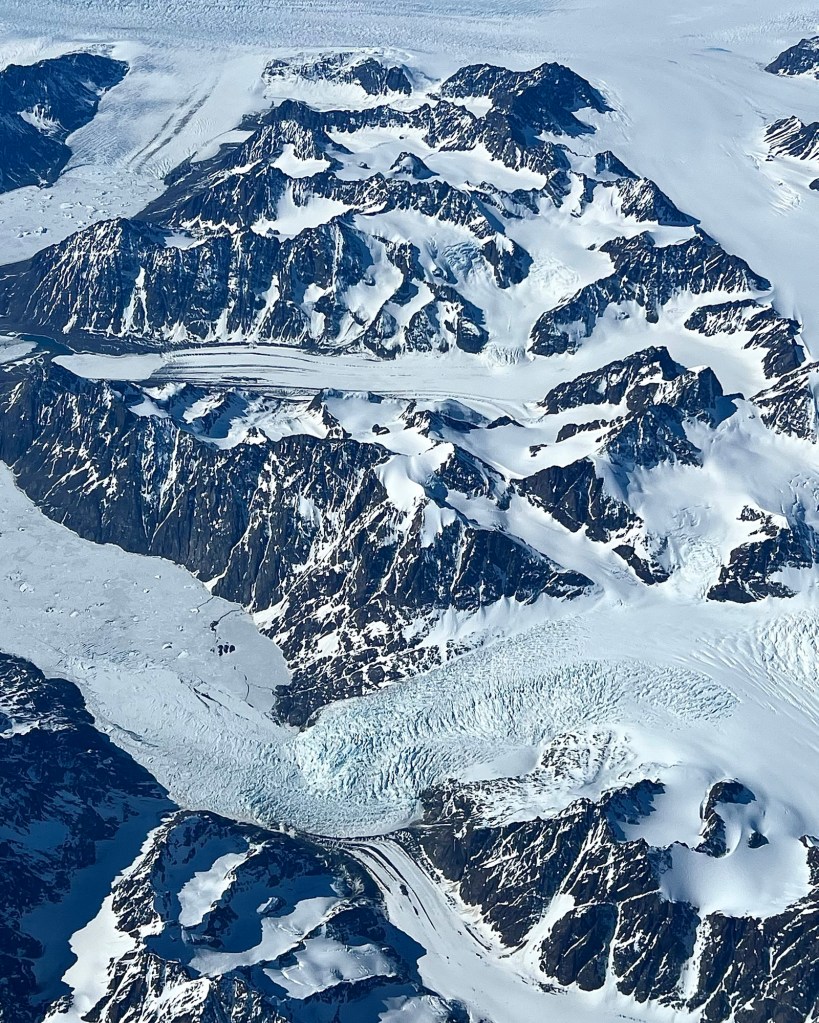
Greenland glaciers
The recent Vance/Rubio meeting with Danish and Greenlandic foreign ministers Rasmussen and Moltzfeldt went nowhere and Trump doubled down on his demands. The fact is that Trump has to be stopped before he goes any further. He is completely out of control with his threats against allies and enemies alike (is there a difference any more?), but to threaten a democratic nation that is also supposed to be a friend and an ally such as Denmark and its island of Greenland is a new low.
Trump sycophant Stephen Miller’s rant vis á vis the primitive notion regarding Greenland that might makes right is wrong, and it’s always wrong. Is this how the United States treats an old friend, an ally?? Is this how Trump carries out his election platform to remove the United States from involvement in wars??
Courtesy of David Parkins
There are only two ways that Trump’s aggressions against Greenland now can be irrevocably stopped before he worsens and we find ourselves likely headed into a major conflict of global proportions.
The first is for other Nordic countries, including Canada, to arm Greenland to the teeth with materiél and troops. The second is that the American people, regardless of politics, must make their overwhelming opposition (a new Reuters/Ipsos poll shows that only 17% of Americans approve of Trump’s efforts to annex Greenland) to this greed-driven scheme known.
Greenland
Standing up to Trump particularly through your representatives and most importantly, as your elections come up this year (a frightening thought making the rounds is that Trump might try to cancel them) is now more important than ever. At the very least, and for the sake of your country’s reputation, your voices need to be heard. That said, all of us need to do what we can to prevent Trump from going forward with this affront to democracy and self-determination.
The following is an opinion piece by columnist Andrew Coyne originally published in The Globe and Mail on August 29, 2025. Given Donald Trump’s behaviour and the unwillingness or inability of those around him, including Congress, to exert some control over him, the issues and questions that Coyne raises in this article are particularly germane, especially in light of Trump’s continued threats against our sovereignty and our right to exist as a country.
Donald Trump is on the brink of becoming a dictator. Can he be stopped?
~ by Andrew Coyne
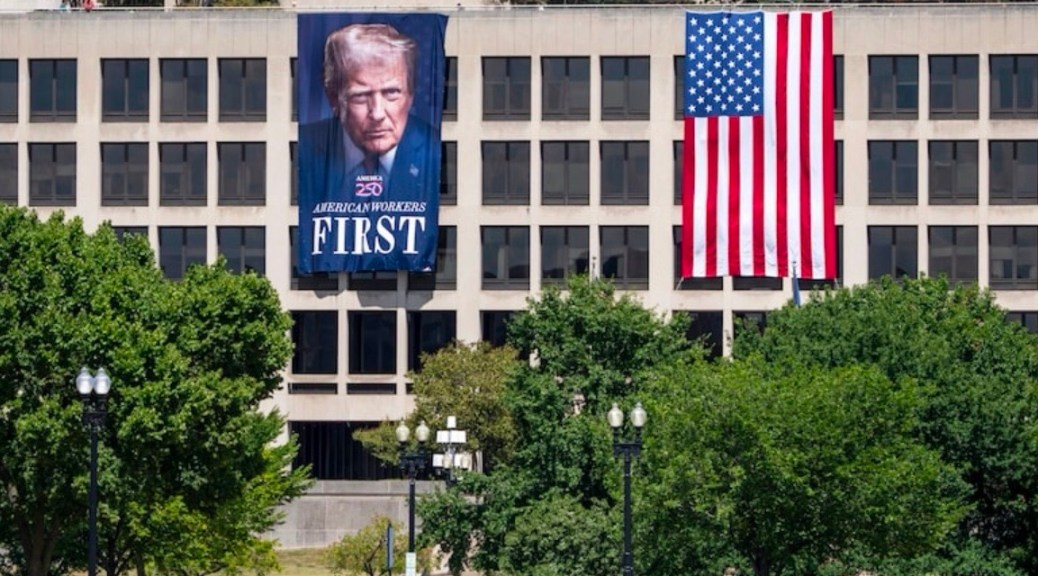
Donald Trump’s giant portrait hangs on the Labour Department headquarters near the Capitol in Washington, on Monday. (Associated Press)
By now it should be clear that the subjection of the United States to the dictatorship of Donald Trump is no longer a theoretical possibility or even a distant probability. It is an imminent reality.
It is not here, quite – critics of the President remain at large, the courts are still attempting to enforce the rule of law, the results of the 2026 and 2028 elections have not yet been determined – but the pieces are being put in place at astonishing speed.
To call what is happening a “slide” into authoritarianism, as if it were something anarchic and uncontrolled, would not be apt. It is more like a cementing. Having slipped back into power by the narrowest of margins, Mr. Trump and his acolytes have been steadily expanding from that beachhead, each new power serving as the means to acquire still more.
Often these powers have been acquired illegally, in brazen defiance of the Constitution. But so long as no one holds them to account for it, and so long as the administration refuses to be held to account, they become ratified by convention, or practice, or sheer nerve, the de facto rapidly congealing into the de jure.
At some point, American democracy will find it is caught, immovably, a colossus in quicksand. The question is whether it has reached that point, or, if it has not reached it yet, whether it can still avoid doing so.
The examples pile up by the day. In recent days, weeks and months, Mr. Trump and his officials have:
Installed National Guard troops and other military forces in the centre of major American cities, first Los Angeles, then Washington, and soon (if Mr. Trump’s threats are to be believed) Chicago, Baltimore and New York, under the guise of fighting crime. Some of the guardsmen are armed; some have been conducting arrests, for which they have neither training nor authority. The D.C. police force was likewise taken under federal control. • Seized thousands of suspected illegal immigrants off the streets, the snatchings carried out by masked Immigration and Customs Enforcement (ICE) agents without badges, their victims bundled into cars without markings, to be sent in some cases to barbaric foreign prison camps, in some cases to their domestic counterparts, without trial, without even charges. ICE is increasingly seen as Mr. Trump’s personal police force. • Initiated criminal investigations into various of Mr. Trump’s antagonists, from Letitia James, the Attorney-General of New York who prosecuted him for fraud, to Jack Smith, the special counsel who prosecuted him for his attempts to overturn the 2020 election and for his handling of classified documents at Mar-a-Lago, to John Bolton, his own former national security adviser who has since become one of his severest critics, to Adam Schiff, the Democratic Senator and lead manager on his first impeachment, to Lisa Cook, the Federal Reserve governor who stands in the way of his desired takeover of the U.S. central bank. • Fired or demoted police officers and prosecutors responsible for bringing the Jan. 6 rioters to justice, having earlier issued a blanket pardon for the rioters themselves. • Threatened television networks whose programs or performers irritated him with suspension of their licences, or adverse regulatory rulings. • Extorted massive settlements from the same networks, or law firms who had acted for his antagonists, or universities he deemed too liberal, or even corporations, like Intel, he fancied a piece of. • Demanded Texas, Florida, Indiana and other states redraw their electoral maps, in a transparent attempt to gerrymander more Republican districts into being in time for the midterm elections; at the same time, Mr. Trump talks openly of banning mail-in ballots, while issuing executive orders demanding “proof of citizenship” for voting and requiring federal review of state electoral rolls. • Fired the head of the Bureau of Labour Statistics for issuing unemployment numbers that displeased him; fired the head of the Defence Intelligence Agency for issuing after-action reports on the U.S. bombing of Iran that likewise disagreed with Trumpian dogma. • Defied court orders with regard to various of the above. • Defied Congress with regard to the spending of money for the purposes for which it was appropriated by Congress, while imposing tariffs that must constitutionally be approved by Congress. • Issued a series of executive orders for which he has likewise no constitutional authority. As if to give visible signs of his intent, Mr. Trump has been furnishing himself with various of the accoutrements of a dictator, from the giant portraits that now hang on government buildings, to the gold-encrusted palace that was once the White House, to the military parade on his birthday, to the endless public displays of sycophancy he requires of his cabinet members. Indeed, he has taken in recent days to musing about dictatorship as a possibility – “a lot of people are saying ‘Maybe we need a dictator’” – as if he were not just trying out the description with the public, but habituating them to it.
Indeed, the portents are ominous. Commit violence on Mr. Trump’s behalf, and he will see that you suffer no penalty. Attempt to stop or prevent it, and he will have you fired or prosecuted. Criticize him, or represent his critics in court, and he will lean on the organization that employs you.
Think the courts will save you? He has stacked many of them, intimidated others, and will have no hesitation in ignoring those that remain. You can see him lining up a test case for the ultimate act of revolutionary disobedience, defying a Supreme Court ruling – maybe over tariffs, or illegal immigrants – and with it finally dispatching with the rule of law altogether.
Certainly he need have no worry about his own personal legal liability: the Court has already found that he is immune from prosecution, at least for acts committed in his “official capacity.” But who would even attempt to bring him to justice? The senior levels of the Department of Justice are filled with political allies or his personal lawyers. The Congress? But both houses are controlled, narrowly, by the Republicans, and while Congresses in the past have been willing to face down a President of their own party, the current GOP is made up of individuals who either share his dictatorial world view or are too frightened of him, and even more of his followers, to stand up to him. That is only likely to grow in line with his powers.
Ah, but there are next year’s midterm elections. Mr. Trump’s approval rating is mired in the high-30s. The Senate may be out of reach, but surely the Democrats can retake the House. Then the process of reeling in Mr. Trump can begin.
But you haven’t been paying attention. What do you think all that gerrymandering is about? Why do you think Trump is ranting about mail-in ballots? What else do you suppose is being arranged at the state level, out of reach of the national media? The chances of a free and fair election in 2026 must be rated at 50-50 at best.
Suppose the Democrats do retake the House. How do they enforce their will on a President who does not recognize the legitimate authority of Congress? By appealing to the Supreme Court? But we know Mr. Trump’s view of the rule of law. How many divisions does the Supreme Court have?
And as you ponder all this, remember: It’s only going to get worse. We are still in the very early days of this presidency. Mr. Trump’s behaviour has grown steadily more outlandish throughout, trashing norms and stepping over boundaries previously considered inviolable even by him. How much more outlandish is it likely to get between now and January, 2029, when Mr. Trump’s term is supposed to end?
Emphasis on: supposed to. As others have observed, Mr. Trump has not been carrying on like someone who expects to leave office in three-and-a-bit years. (That US$200-million ballroom he is building off the White House – or perhaps the White House is off it – is a clue.) He seems entirely unconcerned by the political opposition his actions have aroused, except to revel in the possibilities for repression they open up.
So 2028 rolls around. Maybe Mr. Trump runs again, as he sometimes muses, in violation of the U.S. Constitution. Or maybe he doesn’t. Maybe the election is free and fair, or maybe it isn’t. Maybe he just stays on, indefinitely. But whatever happens, how exactly is Mr. Trump to be removed from the White House? I mean physically.
By that time he will have replaced the entire command structure of the military with his loyalists. And of the intelligence agencies. And of the FBI. D.C. will have been under martial law for three years. Who, or what, is going to arrest him?
If this sounds over the top, then again you have not been paying attention. Everything Mr. Trump does defies belief, let alone precedent. Mr. Trump’s dash for dictatorship is rapidly approaching the point of no return. So the question that has always hovered in the air is now the urgent question of the hour: How can he be stopped – before it is too late?
That Mr. Trump is bent on making himself dictator is no longer in doubt. That he is well on his way to doing so should not be. If democracy in America is to be saved, its defenders must pour all their thought and energy into devising creative ways to frustrate his ambitions. Because they are running out of options, and out of time.
Like many others I watched Donald Trump’s so-called “liberation” speech with great interest. Getting through his mind numbing rhetoric and cavalcade of falsehoods was a feat in itself but important to stick through it, nevertheless. Afterward there was of course the usual analysis and reaction, but what absolutely astonished me was the response of the CBC reporter who attended the speech in person. With an ear-to-ear grin, she crowed about how Canada and Mexico had been left off the list of tariffed countries. In other words, we were escaping additional tariffs – this time.
Yikes. Agreed that we dodged a bullet, but we already have the massive tariffs he imposed last month, so it’s essential that we be extremely aware of something that seems to be eluding us here, and that’s the tendency to begin normalising this tariff situation. We absolutely must not; there’s nothing normal about what Trump is doing to us and Mexico and has now forced on many other parts of the world.
There’s a very famous scientific experiment that has repeatedly been proven to be true no matter the species and no matter the time or place. And that’s that if something is introduced very gradually, no matter how awful it is, we will eventually get used to it.
A frog placed in a pot of hot water will immediately jump out, but if you place him in room temperature water and very slowly turn up the heat, he will stay and die.
A much more extreme example is how Hitler gradually reduced the rights of Jews and other identifiable minorities, bit by inexorable bit, until they had lost absolutely everything, including their lives. The tendency of any species to normalise was part of the reason why he was able to get away with this process.
Because of this tendency, we have to be on guard, now more than ever. The will-he-won’t-he, to-ing and fro-ing, maybe-maybe-not, how-bad-will-it-be tariff puppetry has carried on for months now, amping up the fear and worry and creating sleepless nights and high blood pressure all over this country.
And now, all of a sudden, an escape! The tremendous sigh of relief that the tariffs weren’t worse is a prime example of the mindf**kery we have been subject to since last November. But in reality, nothing much has changed. Many people’s jobs, particularly in the auto, aluminum, steel and lumber industries are on the brink. There are 25% tariffs on anything falling outside of CUSMA (in the U.S. it’s known as USMCA). It’s vitally important to remember that the tariffs already being levied are terrible economic hits that will disrupt our economy and potentially devastate many people’s lives.
Was this an attempt at softening us up so that we will be more compliant once a new PM is in place? I believe so, because I don’t think that Trump has at all changed his mind about subsuming us and turning us into a colony to be exploited. We are still where we were.
It’s therefore vital that we keep forging ahead with plans to diversify, to remove interprovincial trade barriers, and above all to separate ourselves from the U.S. The continued boycott of their products, and especially the avoidance of such conglomerates as Amazon (Bezos), X (Musk), Etsy, eBay and others are crucial as we continue to carve our own path. CUSMA is dead, or will be soon. There’s no going back, and the politicians now trying to get our votes need to understand that without fail.
This opinion piece originally appeared in The Globe and Mail. I believe it’s an incredibly germane article that should be read and considered by all Canadians, especially before we go to the polls on April 28. There are eleven important links throughout the piece; I hope you have the time to go through them.
If You Want Peace, Prepare for War – an Ancient Lesson Canada Must Remember
THOMAS HOMER-DIXON Special to The Globe and Mail Published March 21, 2025
Thomas Homer-Dixon is executive director of the Cascade Institute at Royal Roads University and professor emeritus at the University of Waterloo.
Photo illustration: The Globe and Mail
Si vis pacem, para bellum. If you want peace, prepare a for war. This ancient Roman aphorism is starkly relevant to Canada’s situation today, no matter how contrary it seems to our national culture.
U.S. President Donald Trump believes that the treaty that demarcates the Canada-U.S. border is invalid and that the boundary should be moved. Put simply, he wants to take our land. And the risk of that happening is higher if we pretend it doesn’t exist.
There are people who want to believe that Mr. Trump’s annexation talk is just a tactic to get us to make bigger trade concessions. The tariffs aren’t intended to make annexation easier, they say, but are instead part of a strategy to restructure the U.S. economy, reduce the country’s deficit and lower taxes.
Similarly, until a couple of weeks ago, any suggestion that the United States would use military force against Canada was derided as ridiculous. And anyway, commentators argued, Canada can’t be militarily defended, because our population is strung out in a thin line along America’s northern border.
But those perspectives are shifting fast.
Earlier this week, the renowned Yale historian Timothy Snyder (and visiting professor at the University of Toronto) wrote that “war with Canada is what Trump seems to have in mind.” He highlighted Mr. Trump’s “strangely Putinist” fiction that Canada isn’t real – that we’re not economically viable, that most of us want to join the U.S., and that the border is artificial. The assertion that Canada isn’t real is the kind of lie, Dr. Snyder said, that “imperialists tell themselves before beginning doomed wars of aggression.” It’s preparation “not just for trade war but for war itself.”
Other scholars are now seriously addressing the possibility of war. Aisha Ahmad, a Canadian specialist in failed states, recently argued that an invasion of Canada would “trigger a decades-long violent resistance, which would ultimately destroy the United States.” And last week the military historian Elliot Cohen published an assessment of past U.S. attempts to conquer Canada, with a reminder to the Trump administration that they produced “dismal results.”
You’re likely shaking your head by now. This can’t be possible! But Mr. Trump’s modus operandi is to turn craziness into reality. We need to stop shaking our heads at his craziness and see the new reality he’s creating.
Mr. Trump isn’t just “a quasi-fascist,” said Jonathan Leader Maynard of King’s College University in London in a message to me a few days ago, “but an absolute fantasist who treats things as true because he fantasizes about them. Canada as the 51st state, Gaza as a hotel resort, tariffs making the economy boom, splitting Russia off from China – all these ideas are fantasies. But given free rein, he might pursue any or all of them.”
If one observes Mr. Trump carefully, one can see his tell – an unintended hint of his subconscious fantasy about geopolitics. It’s there in the school-room map on a stand beside his desk in the Oval Office, emblazoned with “Gulf of America.” And it’s there again in his comments on March 13, when he talked about the “beautiful formation of Canada and the United States.”
“It would be one of the great states anywhere,” he said. “This would be the most incredible country visually.”
Mr. Trump is playing the board game Risk, and the main players are the U.S., Russia and China. A nation’s power equates to its visible expanse of territory across a cartoon-like world map. All countries are ineluctably locked into a planet-spanning winner-take-all conflict. And to prevail, the United States needs to absorb Canada (and to take over Greenland and the Panama Canal) not just to Make America Great, but to achieve “hemispheric control,” in Steve Bannon’s eager locution.
Mr. Trump’s board-game imaginings may be fantastic, but they’re creating, day by day, a stark, hard reality: The rules-based international order that originated with the 17th century jurist and philosopher Hugo Grotius – and on which the principle of territorial sovereignty is based – is unravelling. Emerging in its place is something akin to Thomas Hobbes’ state of nature – a world governed by brute force and the will of the strongest.
The unravelling process will take time. An assault on Canadian territory won’t happen soon, not this year, nor likely the next. But if we choose to remain weak, here’s how things could go before the end of Mr. Trump’s term, especially if domestic unrest and dysfunction further radicalize his regime, encouraging it to try to distract attention by picking fights with outsiders.
Mr. Trump will steadily escalate his demands on Canada, tying them to progressively broader political and territorial grievances. He’ll also increasingly question our country’s basic legitimacy as a sovereign nation, as he’s already started to do. A flood of lies from his associates, cabinet members, and the MAGA-verse will paint us as, at best, an irresponsible neighbour that’s not protecting America’s northern flank, or, at worst, an outright security threat, because at any moment we can restrict access to the energy, potash, water and other critical resources the United States needs.
Once we’re framed as an enemy, intelligence and military co-operation (for instance, under NORAD) will end. And at that point – with the U.S. military’s senior ranks purged of resistance and Trump loyalists in place – demands for territorial concessions, explicitly backed by the threat of military force, will be a simple next step. They’ll likely start with something small – an adjustment to the border in the Great Lakes, for instance – as a test of our will. But they won’t end there.
What’s the probability of this kind of scenario? Ten per cent, 5 per cent, or 1 per cent? No one can say for sure. But it’s certainly not zero. And given the existential cost to Canada, we’d be stupid not to take it seriously. In game-theory terms, we need to pursue a strategy of “minimax regret” – to minimize, as best we can, the possibility of worst-case outcomes.
This means, first, recognizing that channelling Neville Chamberlain won’t work. Mr. Trump knows what he wants – our territory – and he’s out to get it. There’s no happy middle ground that can be reached through appeasement. He’ll take our concessions and demand more.
And it means, second, that we need to move to a wartime footing in all respects – economically, socially, politically and (perhaps hardest for us to accept) militarily.
The doubters who say Canada can’t be defended are wrong. Canada can indeed prepare effectively to resist U.S. military force. Scandinavian countries have developed elaborate and popular plans for homeland defence against a massive external threat. We can do the same, starting now by standing up a national civil defence corp, a capacity that would also equip us to better deal with all disasters, natural and human caused.
Already, Canadians in every walk of life are discussing privately how they’re prepared to protect our homeland. True, in any violent contest between Canada and the U.S., we can’t possibly win in a conventional sense. But we can ensure in advance that an authoritarian, imperialist U.S. regime knows the cost will be high enough to make it far less likely to attack in the first place.
The stronger we are, the lower the risks. Si vis pacem, para bellum.
Michael de Adder is a Canadian freelance editorial cartoonist who lives in Halifax, Nova Scotia.
His cartoons, while humorous, sarcastic and satirical, also encapsulate in a single drawing the central kernel of any political or social situation.
Over the years he has taken on very controversial topics and everything else in between from local politics to international issues. By turns, he exposes the foolishness, cruelty and stupidity of the central players in the often opportunistically generated predations that they impose on others.
At one point, he was terminated by a media outlet for his anti-Trump cartoons; this particular outlet had connections to U.S. interests that apparently tried to stop the spread of his criticisms.
Yesterday marked Justin Trudeau’s last day as Prime Minister of Canada.
I wasn’t always onboard with him and during the last several years, often found him frustrating and less than helpful as our country’s leader. But over the most recent two months since he announced his resignation, I’ve come to see something in him that I hadn’t particularly noticed before.
And that’s that he does well in a crisis. When he’s backed into a corner, he comes out fighting, he makes good choices and he doesn’t back down. I think that it’s during those times that he has done the best for us.
At other times, particularly in dealing with the more ordinary, mundane work of government – in other words, the times that take most of the time – he always dithered and slithered; he couldn’t seem to focus, couldn’t seem to stay on point. He often seemed to be flummoxed.
Important campaign promises disappeared, ethical questions started appearing more and more frequently, and his responses and answers to these issues were very unsatisfactory, meaningless word salads.
He wound up doing many of the same things for which he had so vociferously criticised his predecessor, Prime Minister Stephen Harper, and his “sunny ways” were displaced by an extremely micromanaged and divisive governing style. Over his nine-year tenure, there was a lot for which he could – and should – be castigated.
Nevertheless, in the last two months he has done a better job for us than he had done for much of his entire tenure. He toiled away for Canada right up to the last moment, working with the premiers and international leaders, dishing it out to Trump and taking it on the chin when necessary. And yesterday he bowed out with grace and aplomb, with his poised and well-spoken sixteen-year-old daughter introducing his farewell speech and talking about how she is going to be happy to have her dad back.
Of course, hindsight is 20/20 and history will have its say as to how well he did, and as it is for most former leaders, I think we will be more able to see – and accept – his strengths and weaknesses.
But now it’s time to send him on his way, with our thanks and good wishes. We hope he finds success in his future endeavours.
I’m sorry to post this, but if you haven’t heard it yet, please listen and then pass it on. This morning, Prime Minister Trudeau directly addressed the American people and Mr. Trump regarding the imposition of tariffs. Here is the short version:
Here is the complete version.
This trade war will gravely and hugely affect both Americans and Canadians alike. No one will win.
In light of the disastrous meeting between President Zelenskyy and President Trump, where both Trump and Vice-President Vance decided that Zelenskyy wasn’t doing his best Oliver Twist imitation and began slinging vitriol at the victim while supporting the aggressor, I think it’s salient to pass on the following opinion piece from Andrew Coyne. This was originally published by the Globe and Mail on February 28, 2025. Many thanks for this idea from Jane at https://robbyrobinsjourney.wordpress.com
Brace yourselves: whatever crazy, awful things Trump may have done to date, it’s only going to get worse
by ANDREW COYNE
Skate to where the puck is going, not to where it’s been. That bit of trite wisdom, attributed to Wayne Gretzky, might usefully be applied in assessing the risks posed by Mr. Gretzky’s political idol, Donald Trump.
Every time we think we have taken the measure of Mr. Trump, every time we think we have understood the depths of his depravity, the absoluteness of his nullity, the scale of the threat he represents – to American democracy, to Canada, to the peace of the world – he defeats us. He does or says something far worse than we had ever thought possible, even of him.
We need to learn from this, fast. Because Mr. Trump is metastasizing, mutating, rapidly worsening. He is on a kind of exponential spiral, his behaviour approaching levels of madness and mayhem that had never previously been imagined, let alone seen.
Our expectations of him are forever playing catchup to the reality. Which means we are forever calibrating our responses, not to where Mr. Trump is going, but to where he has been. That way lies disaster.
We need to understand that however awful Mr. Trump’s behaviour may have been until now – however callous, dictatorial, insane or dangerous, and however it may seem to have defined the limits of what is possible in each regard – it is only going to get worse, and at a rate that will itself defy all expectations.
Consider Mr. Trump’s performance in just the month or so since he took office. Did even the most alarmist of Mr. Trump’s critics anticipate he would not just undercut Ukraine in its struggle for survival against the Russian invaders, but take the Russian side in every material respect – assigning blame for the invasion not to Russia, but to Ukraine; cutting Ukraine out of the negotiations on its fate, while ruling out NATO membership and the restoration of Ukraine’s territorial integrity in advance; voting with Russia against a UN resolution denouncing the invasion; and demanding Ukraine pay the United States half a trillion dollars in reparations for the offence of having resisted its own annihilation (and decimating the Russian war machine in the process), a figure that is many times the actual amount of American aid it has received?
Did anyone imagine he would not just make similarly extortionary demands of his NATO partners in return for the United States’ “protection,” but effectively signal that no such protection would be provided, should Russia expand its attacks on Europe beyond the multifaceted hybrid-warfare campaign in which it is already engaged? Did even Mr. Trump’s supporters anticipate that he would also telegraph, in the space of the same few fevered days, that he would abandon Taiwan?
Or, closer to home, did anyone imagine that the original Trump threat to Canada – that we would be included in his proposed global tariff of 10 to 20 per cent, notwithstanding our joint membership in a continental free trade area – would suddenly swell into a special 25-per-cent tariff applicable only to ourselves and Mexico, and then into a campaign to forcibly annex the country? Was, likewise, the invasion and seizure of Greenland, or the Panama Canal, ever envisaged?
Did anyone predict, when the pseudo-official Department of Government Efficiency was first announced, what it would become, scant weeks later: a wrecking ball of dubious legal authority, consisting of Elon Musk and his 20-something acolytes, roaming the halls of various government departments firing officials at random and hacking into government payment websites to prevent duly authorized expenditures from being released?
No doubt it was expected that Mr. Trump would pardon some of the Jan. 6 insurrectionists. But was it ever suggested he would pardon all of them, 1,500 at one go, no matter how severe their crimes – or that he would harass, prosecute or dismiss the law enforcement officials who brought them to justice?
All of this, as I say, is just in thr last few weeks. Mr. Trump’s ambitions have grown materially wilder in that time, his actions more senseless, his rhetoric more extreme – he has lately taken to quoting Napoleon on the virtues of executive lawlessness and referring to himself as “the King” – than even in the weeks before then, in the demented interval between his election and his inauguration.
Image courtesy of Craiyon
That was the period, recall, when he made a series of nominations for senior government posts that could only be described as perverse. It was as if he had deliberately selected the worst conceivable person for each position, the person most directly hostile to the mandate of the organizations they were nominated to lead. Thus Matt Gaetz, accused of statutory rape, was nominated to fill the job of Attorney-General; the alcoholic weekend television host and civil war prophet Pete Hegseth, who has been accused of sexual abuse, was nominated to Defence; the paranoid conspiracy theorist and anti-vaccine crusader Robert Kennedy Jr. to Health and Human Services; the Putin apologist and suspected Russian asset Tulsi Gabbard as Director of National Intelligence; the lunatic Kash Patel as director of the FBI.
None of these were suspected, even through the long months that preceded the election, when Mr. Trump campaigned on an increasingly explicit appeal to fascism, while violating one norm after another – questioning his opponent’s racial identity, fabricating stories about immigrants eating pets and promising to round up and imprison 12 million immigrants in camps, prior to deportation.
Mr. Trump’s conduct in that campaign exceeded anything he had said or done since his attempt to overturn the results of the previous election in January, 2021, which was itself far worse than anything he had done in the four long years of escalating insanity that marked his first term in office, which exceeded by a wide margin even the most fearful projections that had preceded it.
The pattern is unmistakable. Mr. Trump’s actions, his statements, his very state of mind, have been growing worse over many years, and not steadily, but at an ever accelerating pace. This is, I suggest, not accidental. It is a function of his malignant narcissism, a narcissism that requires constant demonstrations of his power to dominate others, or at least to outrage them, or at any rate to hold their attention.
But as behaviour that was previously unthinkable comes to be expected, so it becomes harder and harder to sustain the same level of outrage; and as even a constant level of outrage starts to lose its psychological potency – as any drug will, if taken often enough – so Mr. Trump has been forced to increase the dosage of his self-administered narcotic of transgression. The self-destructive lunacy, and the resulting chaos, that would previously have satisfied him is no longer sufficient. He must take things to the next level, and the next, still crazier than the one before – crazier than he has ever previously done, crazier than anyone expects, crazier than anyone could expect.
If you think things are bad now, then, brace yourself: it is about to get a whole lot worse. If you are alarmed at the speed with which the Trump administration has set about dismantling every institution of American government and every pillar of the international order, you must understand that this is not just the initial burst of activity, the “shock and awe” phase after which things will settle down: if anything, the pace will continue to accelerate.
It cannot be otherwise. It is dictated not only by Mr. Trump’s insatiable psychological cravings, but by the ambitions and objectives of the fanatical ideologues and criminal opportunists with which he has surrounded himself: for where the destruction of everything that surrounds him is for Mr. Trump an end in itself, for Mr. Musk and his followers they offer the chance to rebuild a techno-fascist utopia out of the rubble, or at any rate to make off with as much as they can, while they can.
This rather alters the stakes, and the resulting challenge: of comprehension, let alone formulating an effective response. We have not just to understand what Mr. Trump and his team are up to now, but what they are capable of in future. That would be difficult enough in a normal, linear progression. But on the exponential curve on which Mr. Trump is now launched, it almost defies the imagination.
Take everything, then, that Mr. Trump has done in the last few weeks, and how much of an escalation this represents over his performance in the previous months or years. Now project that same rate of change forward over the next few weeks, or months or years: to Mr. Trump’s still nascent efforts to weaponize the justice system against his opponents, for example, or to seize the power of the purse from Congress; to his readiness to defy the courts, to suppress dissent at home and stamp his rule on other countries, and generally sow chaos.
Now apply the same rate of change to the rate of change. That is what we are really up against, and while it is almost impossible to plan on that basis, if we are not at least making the attempt we have not begun to appreciate the true dimensions of the threat that confronts us.
I don’t say for one minute that Mr. Trump will succeed in any of these ambitions. Indeed, it is far more likely that his administration will spin out of control and collapse, overwhelmed by its own internal divisions, by popular opposition and by the multiple cyclones of havoc it has heedlessly set in motion. But that presents challenges of its own.
The world has never before been faced with such a threat. The United States has handed the nuclear codes to a madman, a criminal, a would-be dictator and a moron, all in the same person. Whatever the purpose to which he directs these powers – to impress his dictator friends, to further enrich himself and his cronies, to seize absolute power or just to watch the world burn – we must hope for the best, but prepare for the worst.
Here is an important post from Jane Fritz at Robby Robin’s Journey. She has reprinted an opinion piece from Andrew Coyne, a columnist for the Globe and Mail. Please click the link above to read the post in its entirety.








 In the Net! - Pictures and Stories of Life