
Red barberry is a relatively low-lying and dense shrub that has red edible fruit and green leaves that turn a brilliant crimson in autumn. I have often admired these bushes …

… until I did a little research and learned that they are an invasive species that has caused some rather serious issues.

Because they have a thick, dense thatch, they attract ticks; research indicates that this plant, more than any other, has caused the spread of Lyme disease. These bushes are also responsible for changes in soil nitrogen which in turn leads to a decline in native species.
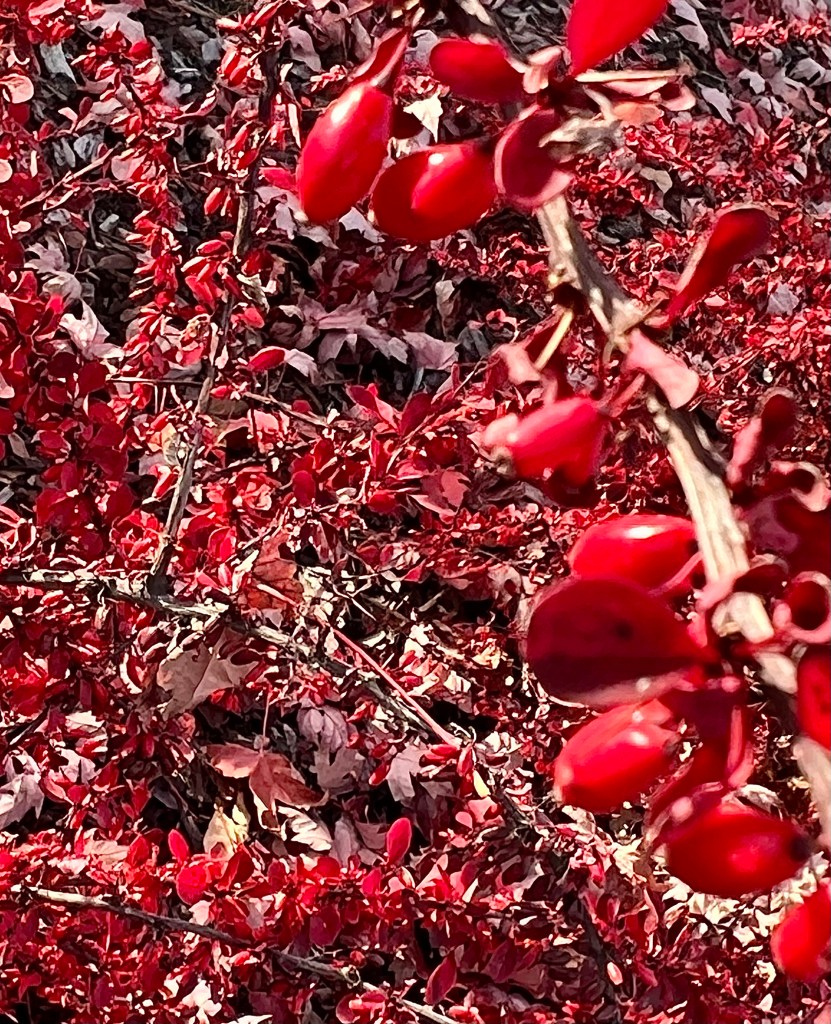
Although they look beautiful and I love their autumn dress, they are banned in many areas – particularly because of tick infestations – and unfortunately should probably be eliminated wherever they are found.
 In the Net! - Pictures and Stories of Life
Interesting post
LikeLiked by 1 person
Thank you. 🙂
LikeLike
Sometimes the loveliest plants and insects turn out to be invasives. I guess possibly the plants are brought to people’s gardens for their beauty, sometimes with the problem insects along for the ride, and then escape to cause havoc.. When we first bought our property, and I wasn’t aware of invasive issues, I planted a row of barberry for a hedge as I had fond memories of them from childhood. They have since been removed but Mary Beth insists on maintaining our inherited burning bushes.
LikeLiked by 1 person
I agree. We buy and plant them because they look nice or make a good hedge but their behaviour is dependent on where they’re from and they can cause so many issues if removed from their evolutionary habitat. I didn’t know about the relationship chain involving barberry, ticks and Lyme disease for instance.
The same thing applies to animals and birds. I recently read about the problems white tailed deer are causing in Finland after the issue was brought to my attention by a WP blogger who lives there.
It seems that in N America there are two types of shrub known as “burning bush” that are both invasive. One is barberry and the other is winged euonymus.
LikeLike
I had no idea 😳
LikeLiked by 1 person
Me either. I was a bit shocked, actually.
LikeLiked by 1 person
The beautiful plants lull us into complacency, whether they be red barberry or purple loosestrife. I have a purple barberry in my front planting bed. It never really gets any bigger, but always puts on a show in the fall. Happy Saturday Lynette. Allan
LikeLiked by 1 person
Thanks, Allan. The barberry bushes really are beautiful, especially in the autumn, and agreed, we often only judge them on how attractive they will be or what kind of privacy they can provide in certain locations.
LikeLiked by 1 person
Great colour, but I’m not a fan of ticks.
LikeLiked by 1 person
I’m not either and hate having to check for them if I’ve hiked in a tick area. Ugh.
LikeLiked by 1 person
That’s the problem with so many invasive species. They’re attractive but can cause a lot of harm.
LikeLiked by 1 person
They sure can. I was a bit shocked really to learn about the connection between barberry and Lyme disease.
LikeLiked by 1 person
The Red Barberry looks gorgeous in the fall. I didn’t know that they were invasive or attracted ticks though.
LikeLiked by 1 person
I love how brilliant it looks in the fall, and even in late summer when the berries start turning red, it’s very pretty. But finding out that it attracts ticks that carry Lyme disease was a big surprise to me, too.
LikeLiked by 1 person
The introduction of alien species is never a good thing. Hopefully, you will get rid of that harmful shrub. In Finland, for example, lupines and wrinkled roses are harmful to native plants because they grow rapidly and take over areas from which they are almost impossible to remove.
LikeLiked by 1 person
I agree. They always cause chain-reaction issues that no one can anticipate (or tries to) when bringing in a species that hasn’t evolved where they’re being planted. Those fast-growing, hardy invasives like lupines or purple loosestrife often change the soil chemistry too, making it difficult for native species to survive which in turn affects bird and animal life. We humans are nowhere near as smart as we think we are.
LikeLiked by 1 person
I agree!
LikeLiked by 1 person
I wasn’t aware of this. Thank you for sharing 😊
LikeLiked by 1 person
You’re welcome. I wasn’t either. It was a disturbing discovery as we have lots of them here.
LikeLiked by 1 person