The honey locust or thorny locust tree is native to North America and in earlier times was an important food source for some indigenous peoples.

The flat bean pods that this tree produces contain a very sweet pulp and the seeds can be used to make flour.

This tree is extremely hardy and will survive droughts, poor soils and even the cold winters of the far north. The wood derived from them is also of good quality and high durability.
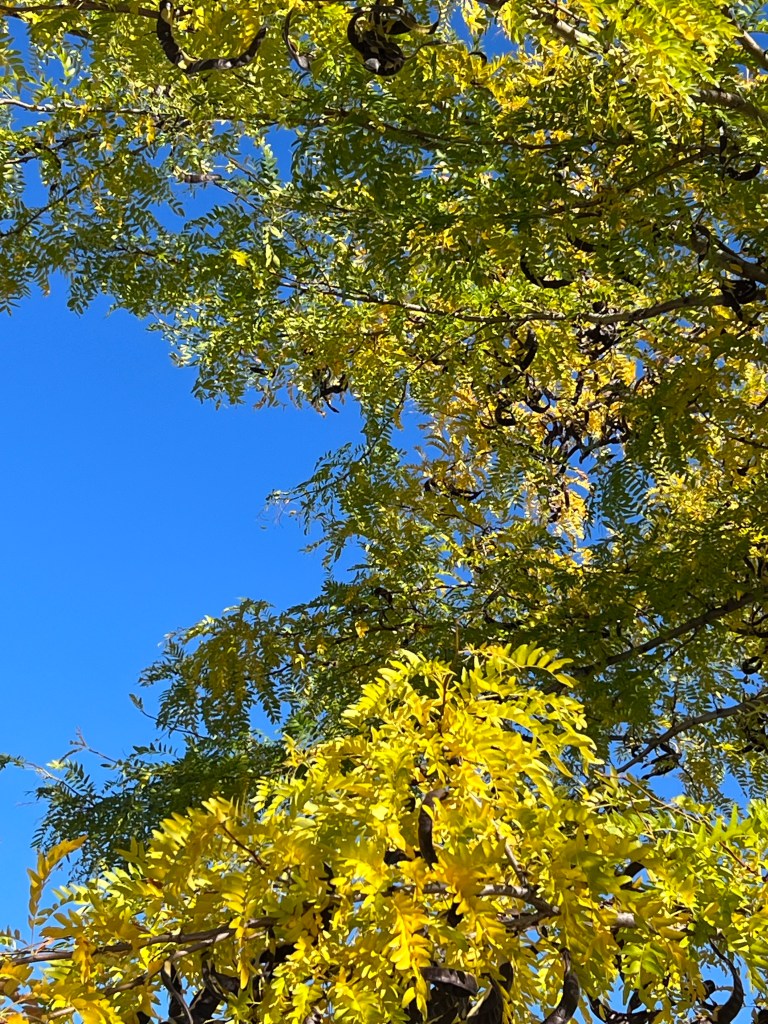
It has a mixed history however, as it’s invasive in Australia and has caused significant problems there as they will take over and choke river and creek beds and the open spaces near them.

Its home is North America where it should stay as it’s a good example of why a species works well in one location but not another. Despite problems associated with this tree, it does put on a very pretty autumn show.
Happy Thursday.
 In the Net! - Pictures and Stories of Life
Love these trees and wish we had a few here. The huge dark pods are so dramatic. Happy Thursday Lyenette. Allan
LikeLiked by 2 people
Thank you, Allan. Yes, those pods are quite beautiful in contrast to the yellow leaves and blue sky (if we have some blue sky). I think they would grow in your area as they withstand the cold quite well.
LikeLiked by 1 person
Hi Lynette – I’m pretty sure we have these trees around where we live. I didn’t know that the pods were a food source. As always, great pictures!
LikeLiked by 2 people
Thank you very much. 🙂 I didn’t know much about these trees until I did a little online research. Apparently the name “honey” is quite apt as the seed pod pulp tastes like melon. I have seen them in lots of places all over N. America so there’s a good chance you have them in your area, too.
LikeLiked by 1 person
Like you, I didn’t know much about these trees and never gave them much thought. Thanks for the interesting “education.”
LikeLiked by 1 person
You’re welcome. I’ve always liked these trees, especially their long, flat, curly pods, but when I overheard someone complaining about how the city needs to replace “these rubbish trees,” I decided to find out why. Cheers.
LikeLike
I’m going to take a closer look on my next walk. We have a lot of the typical trees, pine, oak, maple, but I bet there are others I haven’t noticed mixed in.
LikeLiked by 1 person
Enjoy your “tree walk.” I hope you have lots of colours right now. Cheers.
LikeLiked by 1 person
Yes it’s looking beautiful out there!
LikeLiked by 1 person
Not a fan of these trees. As you mentioned… “problems associated with this tree” are myriad, says this suburbanite.
LikeLiked by 2 people
I haven’t experienced any issues with them (not that I’m in a position to) but I know that they are considered to be “weed trees” in some areas and that the thorns on the younger trees can be awful.
LikeLiked by 1 person
One of my favourite trees!
LikeLiked by 2 people
I like them too although they’re not always good news in some quarters.
LikeLiked by 1 person
Because they’re tall and block the view?
LikeLiked by 1 person
In some countries they’re invasive (especially Australia, where they’re causing a lot of problems with waterways) and even people here (particularly on the prairies) consider them to be “weed trees.” It’s mostly because they’re so tough and prolific, I think.
LikeLiked by 1 person
Tough is the word – the wood is highly prized in shipbuilding.
LikeLiked by 1 person
I didn’t know that but I’m not surprised. Thanks for the info.
LikeLike
Thanks for that infor, Lynette. I didn’t know that about the water.
LikeLiked by 1 person
You’re welcome.
LikeLiked by 1 person
Interesting that those seeds can be used to make flour. With the way the world is going, this may be good information to have in case we’re searching for food in the near future. (Sorry, that’s why I wrote what I did on my blog. World events are concerning me 😝).
LikeLiked by 2 people
I understand, Lori. After the drought and forest fires we experienced in western and northern Canada, the same idea has been in the back of my mind, and now we have a lot of political instability going on as well.
LikeLiked by 1 person
It is a very attractive tree especially against that blue sky! Its natural range doesn’t extend this far east.
LikeLiked by 2 people
Yes, I particularly like the contrast with the blue sky, too. Apparently it will grow almost anywhere if given half a chance, but its less favourable characteristics can mean that it needs to stay put.
LikeLiked by 2 people
I didn’t know any of this about the Honey Locust. It’s always good to learn something new. Thanks Lynette.
LikeLiked by 1 person
You’re welcome. I didn’t know either and always liked these trees until I overhead someone saying that the city needs to replace them since they’re “rubbish.” Then I looked them up.
LikeLiked by 2 people
We have a few of these trees in our neighbourhood. They look pretty in the fall, but their leaves look like a pain to rake given how tiny they are. I didn’t know that they were considered invasive in Australia.
LikeLiked by 2 people
Yes, and apparently quite a problem in Australia since in some areas they will grow in seasonal creek or river beds and also tend to grow in dense thorny thickets that are awful to manage or eliminate. I’ve never had one in any yard I owned but I’ve always liked them and didn’t realise that they can be a problem.
LikeLiked by 2 people